Immediate Power Is the Missing Link Between AI Scale and Sustainability
AI investment has catapulted data center expansion beyond any previous computing wave. But growth is only part of the story. What the industry is discovering, often the hard way, is that AI doesn’t simply demand more power. It changes how power moves.
Large GPU clusters can shift from low utilization to peak demand in milliseconds, creating rapid, repeated step-load surges that strain power quality and stress infrastructure designed for steadier workloads. At ZincFive, we call this AI Dynamic Power: not just higher demand, but volatility, fast changes that occur frequently and with little time to react. Volatility and emerging power demand needs change the design problem entirely. A power system built to handle steady growth isn’t automatically equipped to handle fast, repeated surges without paying a price somewhere else.
The scale of that challenge is significant. The International Energy Agency (IEA) estimates data centers consumed about 415 TWh in 2024, around 1.5% of global electricity, and projects that figure could more than double to roughly 945 TWh by 2030, with accelerated computing for AI as a major driver.
The Regulatory and Procurement Reality
Circularity has shifted from an aspirational goal to a design constraint in Europe and a high-stakes competitive hurdle everywhere else. Under the EU’s recast Energy Efficiency Directive, large data centers must report standardized energy and sustainability KPIs into a European database, with annual reporting ongoing and a public-facing energy efficiency label forthcoming that covers energy and water use and share of renewables. The EU Battery Regulation adds recycling mandates and carbon footprint declaration requirements, with labeling rules taking effect this year.
This isn’t only policy. It’s procurement reality. In the 2025 Data Center Energy Storage Industry Insights Report done by ZincFive in partnership with Data Center Frontier, 87% of data center professionals said sustainability is a priority, and 72% reported moderate or significant cost reductions from sustainability efforts. Sustainability is becoming measurable, and increasingly, economically visible.
2026 Data Center Energy Storage Industry Insights Report
Read PostWhy Overbuilding Isn’t a Long-Term Solution
When AI introduces volatility, the instinct is to add more: more capacity, more redundancy, more layers of hardware and batteries to absorb the shock. The problem is that overdesign is costly, and the cost isn’t only capital expenditure.
Overdesign consumes materials and space. It increases battery quantity beyond what runtime alone requires, driving architectures that stack multiple systems to handle different parts of the problem — one technology for fast transients, another for backup energy. The result is more hardware to manufacture, deploy, maintain, and ultimately retire. That is exactly the lifecycle burden that circularity mandates are designed to reduce.
Data center operators are already feeling this pressure. In the same industry insights report, respondents cited increased energy-efficiency requirements (55%) and the need for higher power density and smaller footprints (54%) as AI’s biggest impacts on power and energy storage. AI is not only increasing demand, it’s forcing the right-sizing conversation. And in that conversation, the most sustainable architecture is often not the one with the most equipment. It’s the one that maintains performance and resilience with the least overbuild.
Mitigation at the Source
If emerging demands and volatility is the defining characteristic of AI Dynamic Power, mitigation must start where those emerging power demands show up first: inside the data center, close to the UPS and critical power path.
A centralized battery system placed near the UPS intercepts sudden surges before they ripple through the rest of the electrical chain. The battery absorbs brief, high-intensity peaks and discharges during rapid troughs, smoothing the power curve. That approach creates three downstream benefits. It reduces stress on upstream distribution and helps maintain power quality. It protects usable compute, keeping GPU clusters operating at full intended performance rather than forcing throttling or derating to stay within electrical limits.

Everything You Need to Know About Nickel-Zinc Batteries (FAQ)
Read PostThis is the role ZincFive’s nickel-zinc (NiZn) technology is built for. NiZn is industry-leading in power density engineered for power delivery and rapid response, precisely the profile that AI Dynamic Power demands. Its non-flammable aqueous electrolyte eliminates the thermal runaway risk associated with lithium-ion, removing the need for suppression systems, added clearance space, and the operational complexity that increases cost, footprint, and carbon impact. Safety, in this case, is an architectural advantage.
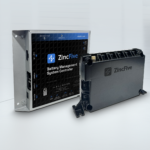
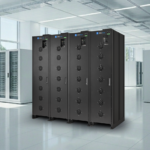
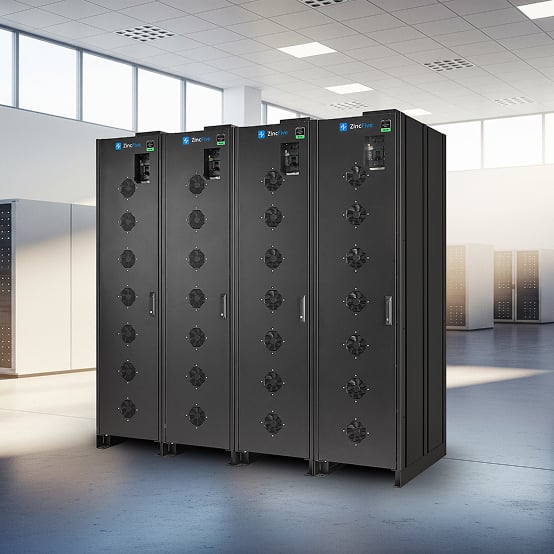
ZincFive’s BC 2 AI UPS Battery Cabinet translates those chemistry advantages into a system engineered specifically for AI infrastructure. Built on high-rate NiZn batteries, BC 2 AI is designed to inject and absorb large bursts of power in milliseconds, allowing it to stabilize the rapid load swings created by GPU clusters before those fluctuations propagate through the UPS and upstream electrical infrastructure. Unlike conventional battery systems built primarily for energy storage, BC 2 AI is optimized for rapid power cycling, enabling it to repeat this sequence millions of times over its lifetime. The cabinet effectively serves a dual purpose: actively smoothing AI dynamic power during normal operation while also providing reliable short-duration runtime protection during outages.
By managing volatility at the battery layer, BC 2 AI allows operators to support high-density AI workloads without overbuilding data center infrastructure.
Power Infrastructure That Is Both Reliable and Responsible
Nickel-zinc batteries deliver reliable performance without compromising safety. Unlike lithium-based chemistries – which may require system shutdowns via battery management systems (BMS) to prevent thermal events – NiZn systems remain operational even when individual cells become weak or depleted, ensuring uninterrupted performance and minimal downtime.
The sustainability case for nickel-zinc technology is equally strong over the full lifecycle. ZincFive’s BC 2 Series UPS Battery Cabinets feature highly recyclable design. At end-of-life, the vast majority of materials are recovered and reused, a recovery rate that lithium-ion systems still struggle to achieve at scale. That performance translates directly to impact: end-of-life recycling offsets more than two metric tons of CO₂-equivalent emissions per cabinet (source: PEP ecopassport). The BC 2 Series is also designed to address both transient response and runtime requirements in a single, modular architecture, reducing the incentive to stack multiple technologies and lowering the total material burden from the outset.
The Accountability Era
The industry is moving toward an environment where power behavior influences grid access, permitting timelines, and procurement scores. How a facility manages volatility — and how responsibly it accounts for the lifecycle of the equipment doing that work — will increasingly shape what operators can build, where they can build it, and at what cost.
The operators who treat power mitigation as a design discipline rather than an afterthought will hold a structural advantage. In the AI era, power can’t just keep up. It has to behave well, and account for itself throughout its entire life.
Previously published by Data Center Dynamics