The Middle East’s AI Ambitions and the Need for a New Class of High-Power Battery Solutions
When Saudi Arabia announced its $100 billion Transcendence AI Initiative and the UAE unveiled its 5-gigawatt Abu Dhabi AI campus in 2025, the headlines focused on the staggering investment figures and geopolitical implications. But buried in the technical specifications of these mega-projects lies a more fundamental question: Can the Middle East’s power infrastructure support its AI ambitions?
The answer requires examining not just power generation capacity, but the entire regional power ecosystem: from the pioneering GCC super grid that has quietly interconnected the power grids of six countries into a single, resilient network since 2009, to the ambitious Red Sea cable projects linking Saudi Arabia to Egypt and beyond.
The competition between Saudi Arabia and the UAE for Middle East AI dominance has produced investment announcements that dwarf most national infrastructure budgets. Beyond the Saudi Transcendence initiative, the kingdom secured $600 billion in AI infrastructure partnerships during Trump’s 2025 visit, Oracle’s $14 billion commitment to cloud infrastructure, and AWS’s $5.3 billion Saudi region development. The UAE has responded with equally massive commitments: the 5-gigawatt G42 AI campus—one of the world’s largest—the$500 billion Stargate project in partnership with OpenAI and SoftBank, and plans to deploy significantly more capacity beyond the current 100 MW Khazna facilities.
The Infrastructure Reality Gap
These AI investments represent a fundamental break from previous infrastructure planning. A comprehensive 2022 analysis of Saudi Arabia’s electrical energy future projected methodical growth based on population expansion and traditional energy demand patterns, anticipating peak demand growth to 84 GW by 2030 from 62.3 GW in 2020, with a total generation capacity target of 123 GW by 2032.
What the 2022 planning didn’t anticipate was the AI infrastructure explosion: NEOM’s 1.5 GW net-zero AI data center, G42’s 5 GW AI campus (equivalent to 8% of Saudi Arabia’s 2020 peak demand), and the reality that AI-focused data centers require up to 10 times more power than traditional facilities. Traditional data centers operate at 5-10 kW per rack, while AI data centers require 60 or more KW per rack. This 6-12x power density increase, combined with gigawatt-scale facility announcements, represents 5-10 GW of unexpected concentrated demand that wasn’t in any 2022 planning scenarios.
Immediate Power Is the Missing Link Between AI Scale and Sustainability
Read PostFrom a pure generation perspective, Saudi Arabia appears positioned to handle this challenge, with current capacity around 66 GW and the region’s abundant energy resources. However, the challenge extends far beyond total power generation to encompass power quality, delivery infrastructure, and cooling systems operating in extreme climates where temperatures can easily reach 50° Celsius during summer.
Regional Grid Foundation: A $50 Trillion Vision Already in Motion
The Middle East isn’t starting power grid integration from scratch. The GCC Interconnection Authority has united the power grids of UAE, Bahrain, Saudi Arabia, Oman, Qatar, and Kuwait into a single, resilient network since 2009. The 400-kV GCC super grid represents a sophisticated engineering achievement, featuring high-voltage direct current (HVDC) systems that connect 50 Hz systems (UAE, Oman, Kuwait, Bahrain) to Saudi Arabia’s 60 Hz system through 1,200-MW HVDC installations with centralized control from GCCIA’s center in Ghunan, Saudi Arabia.
The most ambitious expansion is the Saudi Arabia-Egypt electricity interconnection, representing the first large-scale HVDC link between Middle East and North Africa. This 1,350-km route combines overhead lines and Red Sea subsea cables, with 3 GW total exchange capacity and $1.8 billion investment. Twenty-two-kilometer-long underwater cables are installed/ being installed in the Red Sea, with the first 1.5 GW currently in trial operations.
Regional grid ambitions extend to transcontinental connections: India is planning to link its power grid with Saudi Arabia and the UAE through undersea cables, while the EuroAfrica Interconnector will provide a 2 GW link from Egypt to Cyprus, Crete, and mainland Greece. Such ventures would ultimately tie the GCC, the eastern Mediterranean, and North Africa to Europe to the west and north, and south and central Asia to the east, in a transcontinental grid.
The Technical Challenge: Where AI Meets Reality
While the Middle East offers significant advantages—electricity tariffs ranging from US$0.05 to US$0.06 per kWh, well below the US average of US$0.09 to US$0.15 per kWh, and abundant energy resources—AI creates unprecedented technical challenges. Power delivery challenges in most markets are driven by limitations in interconnecting to the transmission grid, rather than an inability to generate the power, and moving gigawatt-scale power to specific AI facility locations creates transmission bottlenecks that traditional grid infrastructure wasn’t designed to handle.
AI’s microsecond-scale power variation requirements demand a level of power quality that exceeds conventional grid standards, while integrating massive, variable AI loads threatens to destabilize networks designed for predictable, distributed demand patterns. Cooling infrastructure presents equally daunting challenges. Traditional air-cooled chillers, which rely on very cold water (around 4-6°C), struggle when ambient temperatures exceed 50°C, consuming substantial energy. AI compounds this exponentially: air cooling becomes inefficient above 50 kW per rack, necessitating liquid cooling solutions that are both more complex and energy-intensive. In extreme Middle Eastern climates, cooling infrastructure can consume 50% or more of a facility’s total power, creating a compounding effect where AI’s higher power density hinges on even more cooling power.
These challenges require advanced power infrastructure solutions. Traditional UPS systems designed for gradual power ramps can’t handle AI’s microsecond-scale power variations, creating reliability risks that could undermine billion-dollar infrastructure investments. Immediate Power Solutions (IPS) deliver high-rate power instantly, enabling infrastructure to be right-sized for normal operation while meeting peak demand during power surges.
Propelling IPS Innovation
These IPS architecture requirements have driven innovation in the battery technology sector, with companies like ZincFive developing specialized solutions for AI workloads.
At ZincFive, we deliver high-power nickel-zinc (NiZn) battery systems for UPS and other mission-critical applications. Built on NiZn chemistry, our Immediate Power Solutions respond to millisecond-level AI power fluctuations while supporting conventional base-load and backup demands—without the safety, sustainability, footprint, or cost tradeoffs of legacy battery chemistries.

Everything You Need to Know About Nickel-Zinc Batteries (FAQ)
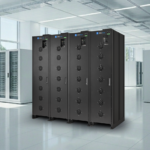
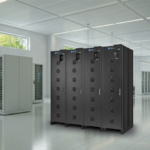
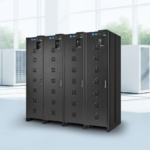
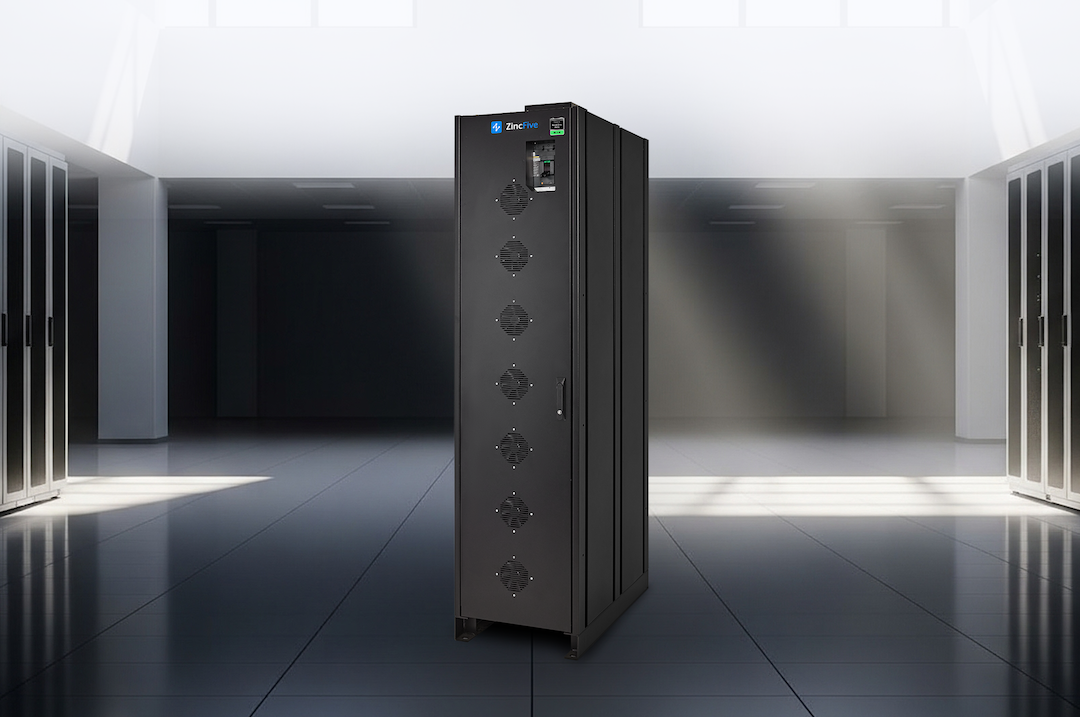
Read PostThis versatility addresses a critical gap in the market, where operators need solutions that can support both legacy IT infrastructure and next-generation AI workloads in the same facility. This approach is exemplified by ZincFive’s BC 2 AI UPS Battery Cabinet, which integrates immediate, high-rate power delivery and reliable backup in a compact, data center–ready footprint.
In addition, ZincFive has already prepared for the extensive EU Battery Regulation 2023/1542, which lays out unprecedented requirements for supply chain transparency and environmental compliance. Technologies that have navigated this regulatory framework—demonstrating compliance with the world’s most stringent standards—offer crucial advantages for Middle East operators seeking international partnerships and investor confidence.
The Path Forward: Transformation, Not Just Scaling
Goldman Sachs Research currently estimates the power usage by the global data center market to be around 55 gigawatts (as of their recent reports), and projects power demand will reach 84 GW by 2027, with AI growing to 27% of the overall market. The Middle East can capture a significant portion of this growth, but success requires recognizing that this isn’t just a scaling challenge—it’s a transformation challenge.
While the region’s energy resources and the 400-kV GCC super grid provide a world-class foundation, the era of theoretical planning is over. The transition from 2022 projections to the 2026 ‘AI Reality’—marked by trial operations of the Saudi-Egypt interconnection and record-breaking solar deployments—demands an unprecedented level of infrastructure sophistication. Success now hinges on more than just scale; it requires real-time grid integration for gigawatt-class campuses, AI-optimized cooling that defies 50°C summer peaks, and a highly resilient regional network capable of balancing constant AI pulse loads with the variable output of 12+ GW of new solar capacity.In order for the Middle East to recognize its AI dreams, advanced power infrastructure deployment will need to be accelerated and cooling technologies will need to be addressed proactively. And, the region should consider leveraging the recent regulatory work that the EU has put in place, which prioritizes sustainability.
The Middle East’s AI race isn’t just about who can invest the most—it’s about whether the region can collaborate to build connected power infrastructure that is sophisticated enough to underpin massive AI workloads.
Previously published by Intelligent CIO Middle East