Nickel-Zinc Redefines Power for the AI Era
Artificial Intelligence (AI) workloads don’t behave like traditional data center loads. They spike, collapse, and surge again in milliseconds. That volatility is forcing a fundamental rethink of how power infrastructure is designed, sized, and deployed.
For decades, uninterruptible power supply (UPS) systems were built around a single moment: the loss of grid power. Everything about their architecture, from battery selection to capacity planning, assumed a relatively stable load interrupted only by rare events.
That assumption no longer holds.
AI Dynamic Power introduces a new operating reality. Workloads can swing from idle to peak demand in milliseconds, with repeated step-load events that stress systems far beyond what they were designed to handle. This is not an edge case. It is becoming the dominant power profile inside modern data centers.
The industry’s default response has been to overbuild. More battery capacity. More headroom. More layers added to absorb volatility.
It works, but at a cost.
According to Data Center Energy Storage Industry Insights Report, total cost of ownership is now a top priority for 84% of operators, while 70% say sustainability criteria are critical in infrastructure decisions. At the same time, 57% cite the need for higher power density in smaller footprints. The margin for inefficiency is shrinking.
Overbuild is a common response today, but it is increasingly difficult to sustain.
What is needed instead is a shift in function. Power systems must move from passive backup to active stabilization. They must absorb and release energy in real time, shaping demand before it propagates through the facility and into the grid.
In effect, data center power infrastructure is no longer just backing up a site; it is enabling the controlled distribution of high-density energy.
ZincFive BC Series UPS Battery Cabinets: Everything You Need to Know (FAQ)
Read PostThis is the role of Immediate Power Solutions.
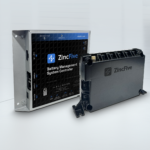
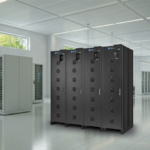
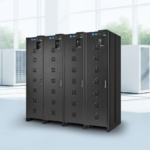
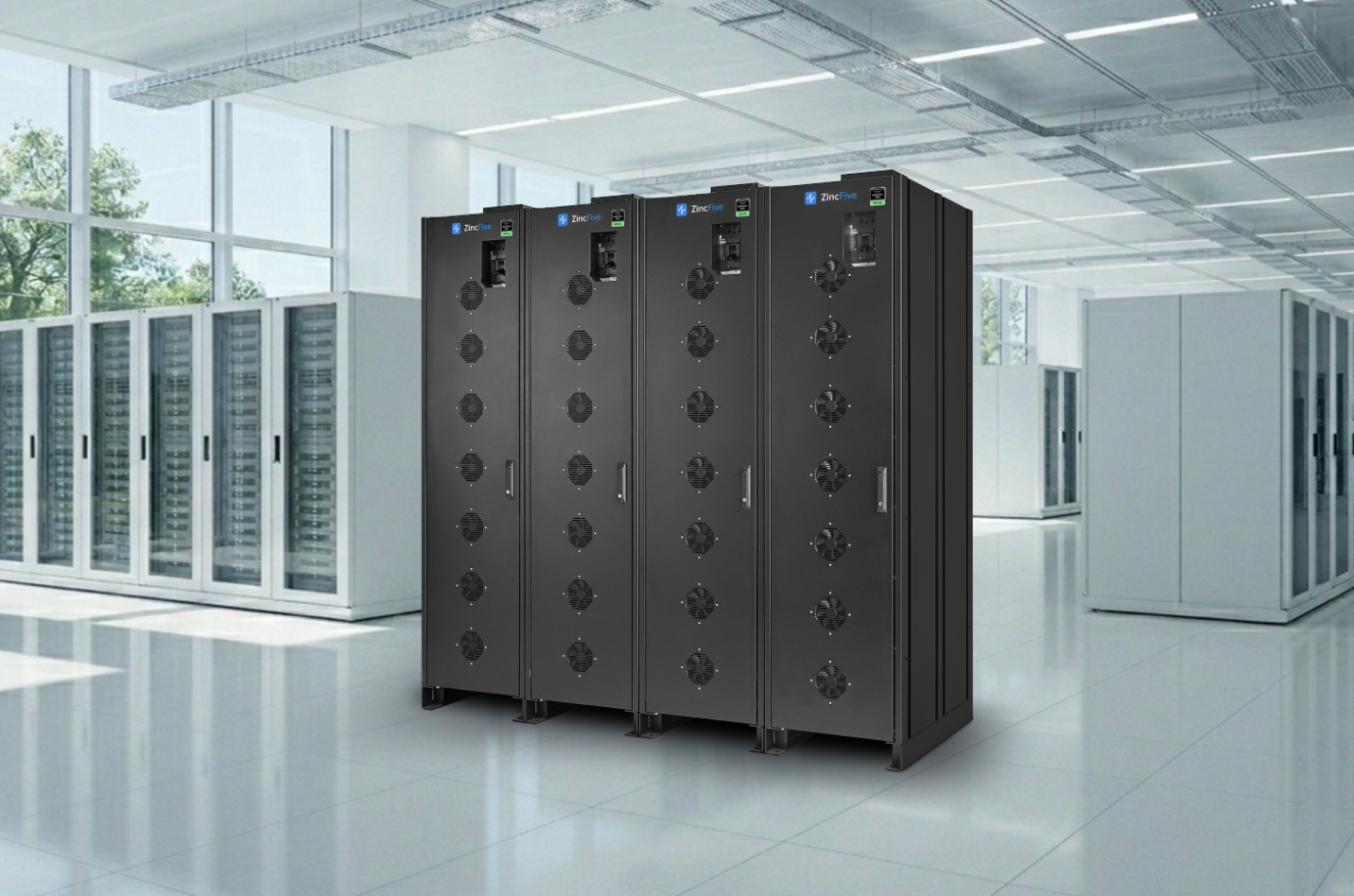
ZincFive’s BC 2 AI UPS Battery Cabinet is designed to operate at that intersection. It intercepts transient load at the UPS, absorbs high-speed power spikes, and recharges during low-demand intervals, combining dynamic load management and backup runtime in a single system.
This dual-purpose approach eliminates the need to stack separate technologies to solve different parts of the same problem. It also enables operators to stabilize peak demand at the source, rather than designing entire systems around worst-case conditions.
The result is performance without compromise.
The advantage is not only architectural. It is chemical.
Nickel-zinc (NiZn) batteries are purpose-built for high-power, rapid-response applications, delivering consistent performance under repeated, high-intensity cycling. That capability translates directly into more usable power in a smaller footprint, a function of NiZn’s high-power density and ability to deliver peak performance without oversizing infrastructure.
Footprint is no longer a secondary consideration. As AI workloads drive higher power density, space inside the data center becomes a constraint. Systems built on high-power chemistries like NiZn enable operators to deliver more power per square foot, reducing not only physical infrastructure requirements, but also the associated costs across cooling, installation, and long-term operations.
Smaller, more efficient systems are not just a design advantage; they are a total cost of ownership advantage.
Instead of oversizing infrastructure to manage volatility, operators can right-size systems to actual workload demands, reducing both capital expenditure and ongoing operational burden.
Safety is equally foundational.
NiZn uses a non-flammable, aqueous electrolyte and does not present the same thermal risks associated with other battery chemistries. This chemistry-driven safety profile simplifies deployment, reduces the need for complex fire suppression systems, and enables installation closer to critical equipment.
In mission-critical environments, fewer layers of mitigation reduce system complexity and total cost of ownership.
Sustainability follows the same principle of efficiency.
Independent, third-party lifecycle analyses show that nickel-zinc systems can deliver 25-50% lower lifecycle GHG emissions compared to alternative chemistries, with more than 90% of base materials recyclable. More importantly, by reducing the need for excess capacity and redundant systems, these architectures minimize the overall material and energy footprint of the data center itself.

Everything You Need to Know About Nickel-Zinc Batteries (FAQ)
Read PostThe most sustainable system is not the one with the most components. It is the one that delivers performance, safety, and resilience with the least amount of infrastructure.
The shift toward modular, adaptable infrastructure reinforces this direction. Nearly half of operators already rely on modular power solutions, with many planning to expand that approach as AI demands evolve. Flexibility is becoming as important as performance.
Beyond the data center, utilities are taking notice.
In power-constrained regions, how a facility behaves at the point of interconnection is increasingly important. Large, unmanaged load swings can impact grid stability and influence interconnection timelines. Systems that smooth and stabilize demand internally can change how capacity is allocated and how quickly projects move forward.
AI is not just increasing power demand. It is changing the shape of that demand.
The infrastructure that succeeds will not be defined by how much capacity it can stack, but by how intelligently it can manage power in real time.From backup to immediate power. From overbuild to precision. From static design to dynamic response. Delivering performance, safety, and sustainability without compromise is no longer aspirational. It is the new requirement for powering the AI era.
Previously published in Data Center Knowledge