New Battery Capability for Dual-Use UPS and AI Factory Dynamic Power Management
Description
As GPU-centric Artificial Intelligence architectures push rack power densities to unprecedented levels, data center operators face severe power supply stability challenges from dynamic power transients that spike 50% or more above continuous loads. While traditional lithium-ion batteries and supercapacitors solutions are available, groundbreaking research from ZincFive demonstrates how Nickel-Zinc (NiZn) battery chemistry provides a true dual-use capability—simultaneously handling core Uninterruptible Power Supply (UPS) backup and active AI factory dynamic power management. Delivering sub-millisecond response times and inherent thermal safety without runaway risks, NiZn technology offers a proven, cost-effective blueprint to mitigate dynamic load fluctuations without compromising space, safety, or budget. Download this white paper to review empirical test data and future-proof your high-density AI data center power strategy.
Key Takeaways
- Ultra-Fast Response Rates: Nickel-zinc delivers 60 W per cell of AI pulse mitigation power in just 25 µs at a current ramp rate of 2 A/µs.
- Exceptional Cycle Life: Maintains an 87% recoverable State of Health (SOH) and 73% State of Charge (SOC) after over 10 Million dynamic power discharge cycles (50 ms load pulses), representing more than 2,777 total capacity turnovers.
- Greater Flexibility: Extends nickel-zinc technology across both backup power and dynamic power applications, including transient mitigation and pulse power support.
- Thermal Safety & Cost Efficiency: Inherent safety of nickel-zinc eliminates thermal runaway and fire propagation risks, offering operators a safer, footprint-optimized, and more economical alternative to supercapacitors and lithium-ion batteries.
Register to read full paper
Abstract
Artificial Intelligence (AI) data centers with Graphics Processing Unit (GPU)-centric designs create increasing IT rack power density and power supply stability challenges. The cyclical nature of GPU-centric AI processing creates dynamic power demand that is 50% or greater than the average continuous IT rack load power, with load transients that typically last up to a total of 50 milliseconds (ms) per second, and transient load occurrence rates ranging from very infrequently to multiple times per second. This paper assesses the dual-use capability of nickel-zinc (NiZn) battery chemistry to mitigate AI dynamic loads while complementing well-established NiZn Uninterruptible Power Supply (UPS) backup power functionality. The conclusion is NiZn does exhibit required dual-use capability with demonstrated dynamic power cycle life performance exceeding 10 Million (M) cycles.
Keywords— AI data center, GPU, nickel-zinc battery, power transients, power density, AI pulse load mitigation, safety
Introduction
The emergence of Graphics Processing Unit (GPU)-centric Artificial Intelligence (AI) data centers poses significant energy and power management challenges for data center operators. Exponential increases in GPU rack power density, coupled with an increasing need for larger clusters of GPUs to support advanced AI training models, are the main drivers of increasing dynamic power requirements in AI data centers1. Adding to this burden is the nature of accelerated computing via GPUs, which results in dynamic power transients of 50% or greater than average continuous load power, typically, for up to a total of 50 milliseconds (ms) per second. Depending on the computational task, GPU load power transients may not occur, may occur only intermittently, or may repeat multiple times per second2. Operating GPU clusters in this fashion requires data center designers and operators to rethink the management of power transient impact, which varies based on GPU workloads and existing data center power infrastructures. One key question facing data center designers is where, in the power distribution system, is best to intercept dynamic power transients to minimize the impact of transient GPU loads on data center primary power sources. The answer to this question is based in part on the economics and technical feasibility of extending existing Uninterruptible Power Supply (UPS), in-rack Battery Backup Unit (BBU), or future sidecar AI data center infrastructure to provide desired dual-use backup power and dynamic power mitigation functionality. The urgency to find a dual-use solution is driven by the inability of lithium batteries or supercapacitors to provide dual-use functionality.
Motivation of Work
Storing available energy in batteries and releasing it to support intermittent loads is a common solution for buffering the dynamics of renewable energy sources like solar or wind power. This work assesses the capability of nickel-zinc (NiZn) battery chemistry to similarly address AI data center dynamic power challenges. AI data center storage solutions require sub-millisecond response times, acceptable power and energy density, safe operation under all conditions, and sufficient dynamic power cycle life to support practical use in high-performance AI data center environments. NiZn battery chemistry is a well-known option for high-rate discharge applications like UPS, with fully demonstrated power density and reliability3. The motivation of this study was to evaluate the following key performance characteristics for assessing the suitability of NiZn battery chemistry as an AI data center dynamic power mitigation alternative to lithium batteries4 or supercapacitors.
- Cycle Life: What is the cycle life performance of NiZn battery chemistry for a 50 ms per second load profile?
- Response Time: What is the discharge response time (e.g., on/off) of NiZn battery chemistry compared to the target of < 1 millisecond target?
- Discharge Power: Can NiZn battery chemistry provide acceptable discharge power for a 50 ms per second load profile?
Experimental Setup
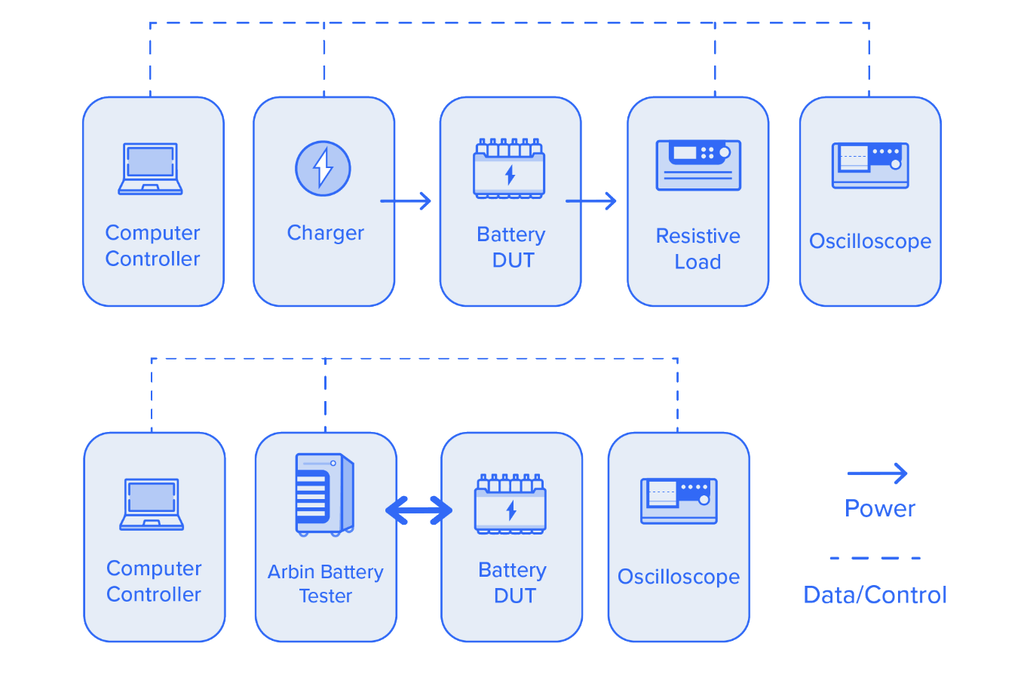
The test circuits shown in Fig. 1 were used to characterize the pulse power performance of a 1.8 Amp-hour (Ah), 3 Watt-hour (Wh) cylindrical model Z5 1.7-2 H X SC NiZn SubC cell with 2.2 cm diameter by 4.2 cm length dimensions. The initial 4.5 Million (M) pulse power cycles were conducted using a constant resistive load and a >60 watts per cell discharge target for 50 ms. The secondary 4.5 M to >10 M pulse cycle life tests were conducted using a standard Arbin LBT cycler programmed to provide a minimum 60 watts per cell constant power load. Both the 50 ms constant resistance and constant power discharges were followed by 950 ms of float recharge before the subsequent 50 ms discharge. The two sets of sequential test results are described below.
Investigation and Results
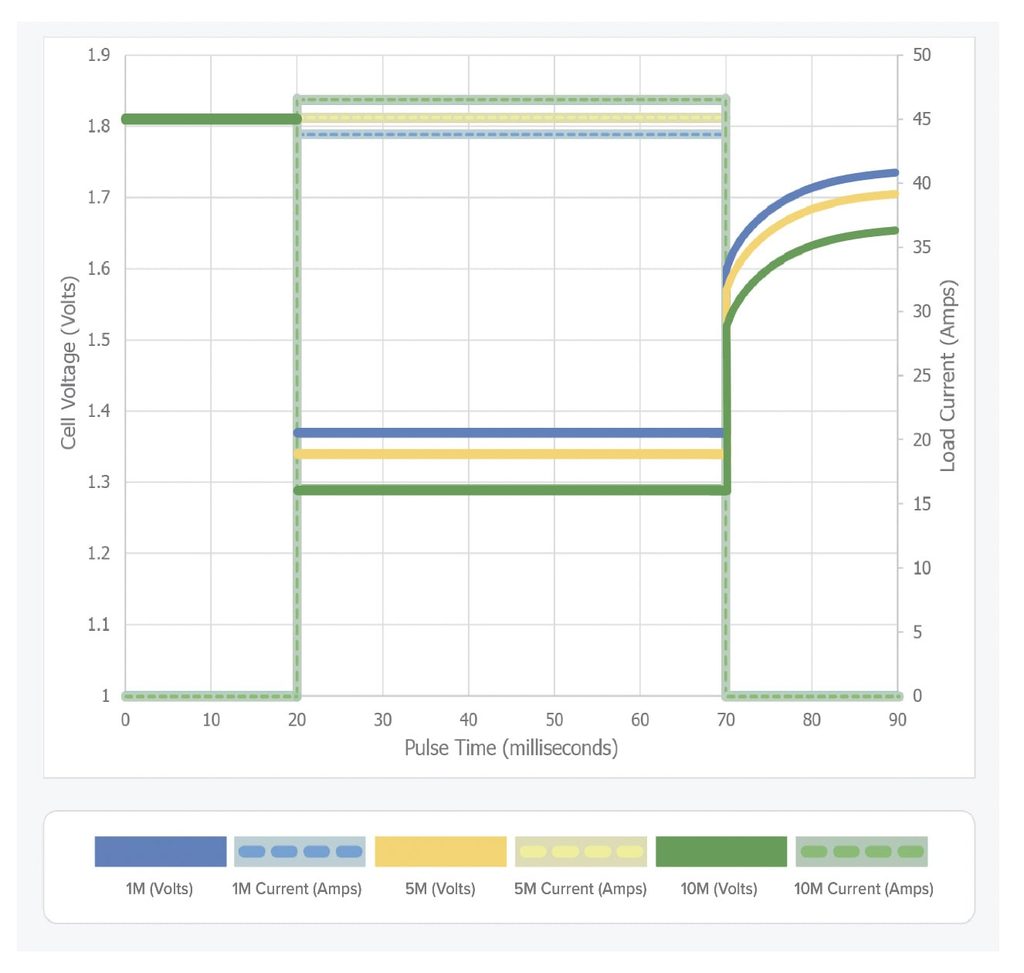
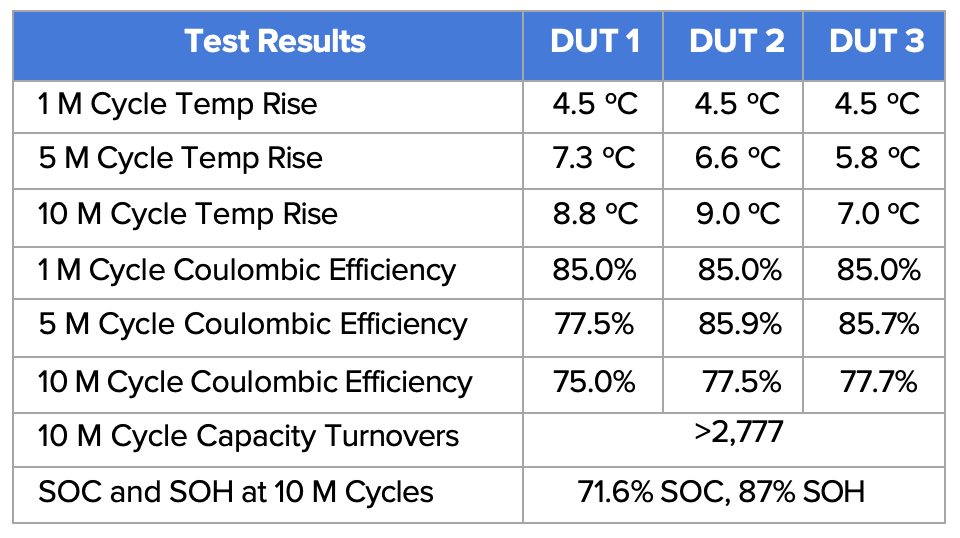
Fig. 2 illustrates the average 50 ms per second discharge voltage and current characteristics of the DUTs 1, 2, and 3 at 1 M, 5 M, and 10 M pulse cycles, respectively. The average discharge voltage decreases with cycle count, with a concomitant increase in average current to maintain the imposed constant power pulse. Table 1 shows the temperature rise for the DUTs at all three cycle life check points. The DUTs were initially connected in a string, which is why the 1 M cycle results for temperature rise above ambient are the same for all three DUTs. The temperature of all DUTs increases with cycling which is consistent with expected aging effects and with the measured reduction in coulombic efficiency.
Total measured Capacity Turnovers (CTOs) for all three DUTs was >2,777 for 10 M cycles of 60 Watts Per Cell (WPC), 50 ms discharges from the 3 Wh NiZn cell. Actual CTOs exceeded this calculated result because average power discharged into the resistive load was greater than 60 WPC. At 10 M cycles, the State of Charge (SOC) was approximately 73% and recoverable State of Health (SOH) was 87%. This equates to the ability to support >2400, 50 ms per second discharge pulses (40 minutes maximum pulse load mitigation) without the need for recharging. Current ramp rate (di/dt) measurements conducted at the University of Texas, Arlington exhibited 2 A/µs response times, which equates to the delivery of 60 WPC (20 Energy Rate) of AI pulse load mitigation power in 25 µs, far exceeding the 1 ms response time requirement.
Conclusion
GPU-centric data centers need safe, dual-use energy storage technology options to provide both UPS backup power and AI dynamic power mitigation. This research shows NiZn battery chemistry has the power density, energy density, and cycle life potential to economically achieve the desired dual-use AI system performance. The fast response performance of NiZn, combined with exceptional cycle life and a lack of thermal runaway or fire propagation risks, enables the next generation of large-scale and higher power density energy storage options for AI data centers. The next steps for dual-use NiZn battery AI applications research are:
- Improvement of the NiZn power, response time, and cycle life performance shown in this paper
- Dual-use BBUs with higher power density and lower costs than single-use BBU alternatives
- Dual-use ±400 V and 800 V sidecar cabinets without need for DC-DC converters5
- Integration into power electronics to improve system flexibility, cost, and performance
Acknowledgment
ZincFive extends our gratitude to Dr. David Wetz and the research team at the University of Texas, Arlington Pulse Power and Energy Laboratory for the high frequency test support that made this study possible.
References
- Deloitte, “GenAI power consumption creates need for more sustainable data centers,” Deloitte Insights, 2025. [Online]. Available: https://www2.deloitte.com/us/en/insights/industry/technology/technology-media-and-telecom-predictions/2025/genai-power-consumption-creates-need-for-more-sustainable-data-centers.html. [Accessed: Jun. 14, 2025].
- Schneider Electric, “Data center power infrastructure for AI applications,” White Paper 126. [Online]. Available: https://www.se.com/ww/en/download/document/SPD_WP126_EN/. [Accessed: Jun. 14, 2025].
- ZincFive, “Home,” [Online]. Available: https://www.zincfive.com. [Accessed: Jun. 14, 2025].
- Skeleton Technologies, “Why AI data centers need supercapacitors,” Skeleton Blog. [Online]. Available: https://www.skeletontech.com/skeleton-blog/why-ai-data-centers-need-supercapacitors. [Accessed: Jun. 16, 2025].
- NVIDIA, “NVIDIA 800V HVDC architecture will power the next generation of AI factories,” NVIDIA Developer Blog, Apr. 2024. [Online]. Available: https://developer.nvidia.com/blog/nvidia-800-v-hvdc-architecture-will-power-the-next-generation-of-ai-factories. [Accessed: Jun. 16, 2025].
-

Featured Papers A Comprehensive Guide to the U.S. Codes and Standards for Energy Storage Systems (ESS)
This white paper provides an informational guide to the United States Codes and Standards regarding Energy Storage Systems (ESS), including battery storage systems for uninterruptible power supplies and other battery backup systems.
June 28, 20241 / 2 -

Featured Papers Climate Impact Profile
Advanced energy storage solutions are increasingly needed to transition the electricity grid, transportation, building and industrial sectors towards renewable energy sources. ZincFive’s nickel-zinc battery is a high-capacity battery with environmental and safety advantages.
June 28, 20242 / 2