ZincFive Battery Management System (BMS): Everything You Need to Know (FAQ)
Elevating Battery Management to a Strategic Differentiator
As critical power environments and modern data centers evolve to meet the compute demands of artificial intelligence, high-density GPU racks, and mission-critical cloud workloads, battery infrastructure can no longer rely on generic or background monitoring systems. Power density, system availability, cybersecurity compliance, and operational simplicity are now fundamental requirements for data center operators, UPS OEM channel partners, and system integrators alike. At ZincFive, our commitment to continuous improvement drives us to refine not only our core electrochemistry, but also the intelligence layer that manages it.
The ZincFive Battery Management System (BMS) is a purpose-built battery management system designed specifically for nickel-zinc (NiZn) technology. Assembled in the U.S., designed and supported entirely in-house by ZincFive across hardware, software, and firmware, every ZincFive BC Series UPS Battery Cabinet ships with the ZincFive BMS as its primary operational interface. Built upon years of real-world NiZn deployment experience in mission-critical facilities, the ZincFive BMS transforms battery management from a back-end technical component into a strategic differentiator.
This comprehensive FAQ guide provides an in-depth look at the architecture, NiZn-native intelligence, enterprise cybersecurity, AI pulse capability, and deployment benefits of the ZincFive BMS.
Frequently Asked Questions
FAQ: System Architecture & Hardware Engineering
What is the ZincFive BMS, and why is it purpose-built for Nickel-Zinc?
The ZincFive BMS is a purpose-built battery management system designed specifically for nickel-zinc electrochemistry, serving as the foundational intelligence platform across present and future ZincFive battery products.Unlike other platforms calibrated for lead-acid or lithium-ion chemistries, the ZincFive BMS features alarm logic, protection thresholds, and State-of-Charge (SOC) / State-of-Health (SOH) algorithms natively calibrated to the physical behavior of NiZn. Because ZincFive designs, develops, and supports the complete system—including hardware, software, and firmware—customer requirements and system enhancements are addressed directly without third-party delay.
How does the two-tier hardware architecture simplify system monitoring?
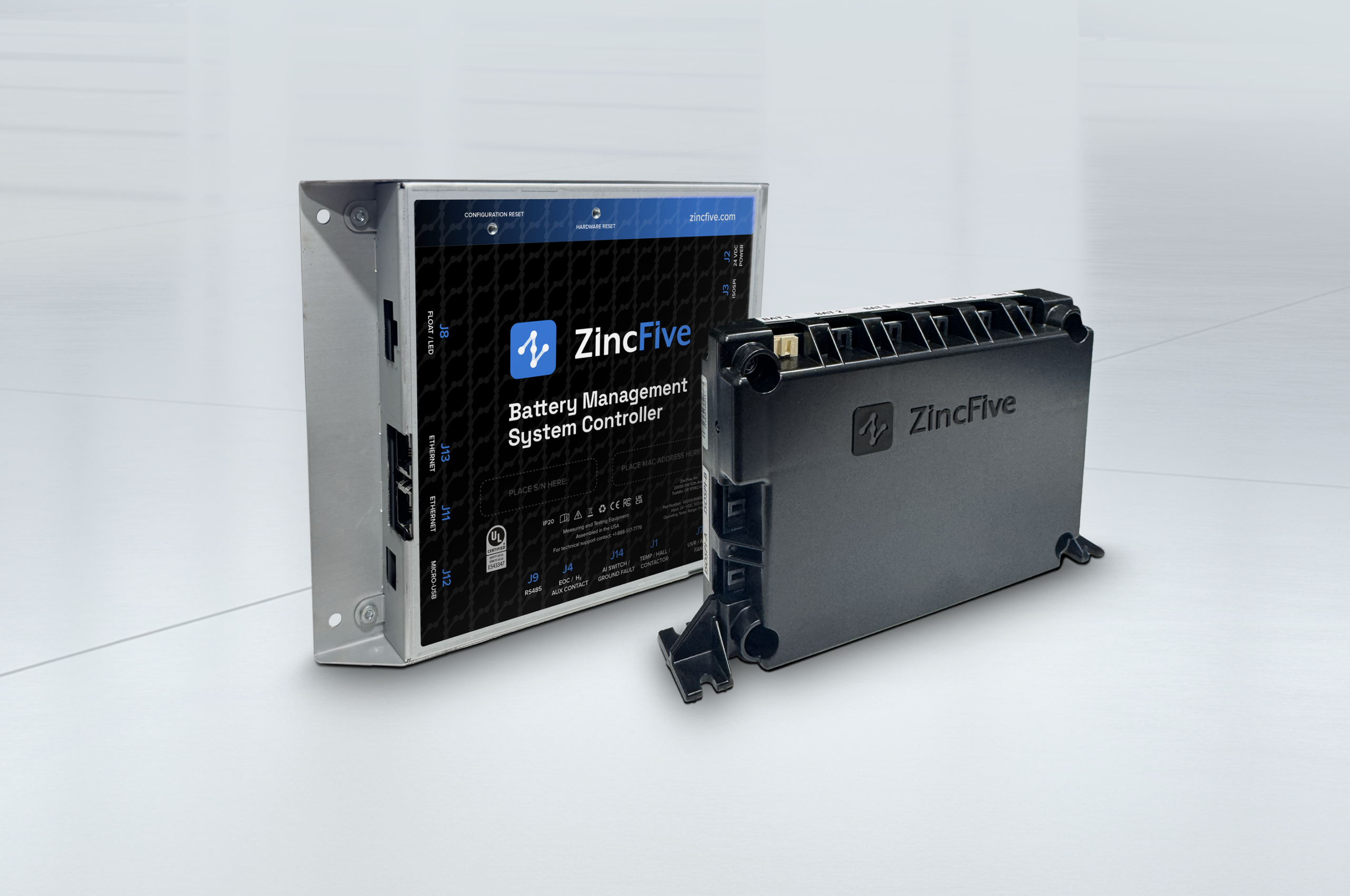
The ZincFive BMS introduces a streamlined two-tier hardware architecture comprising two primary components:
- ZincFive Controller: Serves as the central intelligence hub for the cabinet, aggregating system data, managing communications, executing protection logic, and interfacing directly with building management systems and cloud platforms.
- ZincFive Tray Monitor: Monitors battery performance at the tray level,
This telemetry feeds accurate, real-time SOC and SOH data to both the ZincFive Controller and the UPS.
How does the architecture reduce installation complexity and hardware overhead?
In traditional battery monitoring setups, system cabling often requires external unmanaged network switches, data aggregation hardware, and complex intermediate wiring harnesses. The ZincFive BMS eliminates these requirements at the battery system level through built-in Ethernet ports on every cabinet. Cabinets daisy-chain directly to one another via standard network cabling. This streamlined design significantly reduces cabinet wiring complexity, eliminates third-party network hardware overhead, minimizes potential human wiring errors, and decreases total installation time on-site.
FAQ: NiZn-Native Intelligence & AI Pulse Capability
How do NiZn-calibrated SOC and SOH algorithms benefit operators?
Approximating State-of-Charge (SOC) or State-of-Health (SOH) using algorithms designed for lead-acid or lithium platforms can lead to inaccurate battery status reporting, unnecessary nuisance alarms, or mismanaged maintenance schedules. By using algorithms calibrated directly to NiZn chemical charge/discharge curves and operational parameters, the ZincFive BMS delivers exact, reliable battery status metrics. Operators gain true visibility into available runtime and battery health without operational complexity.
Is the ZincFive BMS standard across all ZincFive cabinets?
Yes. Every ZincFive battery cabinet ships with the ZincFive BMS pre-installed and configured, making it the standard primary interface through which operators, service technicians, and partners interact with ZincFive technology. It acts as the core platform upon which all current and future ZincFive battery innovations are developed.
FAQ: Enterprise-Grade Cybersecurity & System Integration
How does the ZincFive BMS meet modern data center cybersecurity standards?
Rising cybersecurity threats to Operational Technology (OT) and Building Management Systems (BMS) require robust security measures beyond basic network access. The ZincFive BMS is engineered from the ground up with enterprise-grade security features:
- Data Encryption: Protects internal and external data transmissions against interception.
- Device Authentication: Ensures only authorized devices can communicate with the system.
- Hardened Communications: Protects management interfaces against unauthorized network intrusions.
- Access Control: Provides a multi-tiered user permissions hierarchy to control access rights for operators, integrators, and service personnel.
These features deliver an audit-ready, security-compliant battery monitoring infrastructure suitable for hyperscale, enterprise, and colocation requirements.
What protocols and management interfaces are supported for system integration?
The ZincFive BMS supports industry-standard industrial and facility communication standards:
- Modbus TCP/IP: Standardized communication interface for seamless integration with UPS OEM systems, DCIM platforms, and industrial SCADA networks.
- Web User Inerface (UI) An intuitive web interface allowing operators and system integrators to commission cabinets, configure parameters, and manage battery fleets across single or multi-site deployments.
- Remote Firmware Updates: Enables secure, centralized firmware updates across the fleet without requiring physical technician intervention at every individual cabinet.
Conclusion: Purpose-Built Intelligence for Mission-Critical Power
The ZincFive BMS elevates battery management from a basic background component into a strategic operational capability. By combining NiZn-native algorithms, a streamlined two-tier hardware architecture, built-in AI pulse handling, and enterprise cybersecurity, the ZincFive BMS delivers a smarter, safer, and easier-to-manage battery infrastructure for mission-critical facilities. Fully supported and developed in-house, it reflects ZincFive’s years of operational deployment experience and engineering maturity.
To learn more about integrating ZincFive BC Series UPS battery cabinets equipped with the ZincFive BMS into your facility, contact our application engineering team today to request product documentation, arrange a technical demonstration, or evaluate system specifications.
RELATED READING:
ZincFive BC Series UPS Battery Cabinets: Everything You Need to Know (FAQ)
Everything You Need to Know About Nickel-Zinc Batteries (FAQ)
Inside the Evolution of the ZincFive BC Series: What’s New and Why It Matters (FAQ)