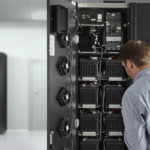
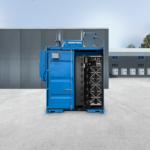
Both new models are powered by a new ultra-high-rate monobloc battery from ZincFive – the Z5 13-90. This ultra-high-rate battery, while maintaining the same case size as its predecessor, now delivers even greater energy and power thanks to a boost in both amp-hour capacity and a remarkable 50% increase in maximum current carrying capability.
2023 Highlights: Product Launches, Partnerships and Good Chemistry
December 21, 2023

Across the data center industry, 2023 brought sustainable backup power solutions into the spotlight. Industry-wide conversations and events placed renewed priority on technologies that balance safety, cost efficiencies, and environmental impact. As the effects of climate change become more severe, milestones from COP28 to rising private sector commitments gave momentum to accelerate the adoption of cleaner, safer backup capacity.
As 2023 comes to a close, we want to take this opportunity to highlight ZincFive’s major achievements, milestones, and collaborations that made the year such a success!
Breakthrough Products Offer Unmatched Power Density
This year, we proudly launched two new product offerings within the BC Series UPS Battery Cabinet lineup: the BC 2 – 500 and the BC 2 – 300X. We also announced a new ultra-high-rate battery, the Z5 13-90, which will power the new battery cabinet models.
The latest BC 2 – 500 and BC 2 – 300X products demonstrate our unwavering commitment to delivering the most compact footprint per kilowatt, showcasing consistent advancements with each new release, and surpassing the already industry-leading footprint of ZincFive’s original BC 2 battery cabinet.

We also expanded our presence in the electric vehicle (EV) charging and microgrid markets through our EV Charging solution collaborations with Kaizen Clean Energy (KCE) and Advanced Power & Energy (AP&E).
Joining Forces with Industry Leaders
This year cemented ZincFive’s status as the go-to provider for sustainable backup power solutions as we formed major partnerships with globally recognized leaders across critical industries. In October, electrification and automation technology leader ABB added ZincFive as an approved supplier, allowing ABB to deliver UPS systems that include safe, green ZincFive NiZn battery solutions.

ZincFive and ABB Work Together to Bring Safe, Sustainable Energy Storage to the Data Center UPS Market
Read MoreZincFive also signed an agreement to license our nickel-zinc-based UPS technology to Econolite, part of Umovity and the leader in One-Stop-Shop advanced traffic management solutions. Econolite will have worldwide rights to manufacture, sell, and service ZincFive’s industry-leading nickel-zinc based UPS technology to the intelligent transportation market. This global reach will use our safe, reliable, and sustainable technology to improve mobility worldwide
Industry Awards Honor Pioneering Innovation
This year, we were honored to have our technology, innovations and sustainability leadership recognized by awards from Mission Critical Magazine and S&P Global. We won the 2023 Mission Critical Magazine Top Tier Product Award in the UPS Systems category for our BC 2 UPS Battery Cabinet. The BC 2 Battery Cabinet was selected for the unparalleled power density, reliability, industry-leading footprint, and unmatched safety it offers in UPS applications for data centers and other mission-critical environments.

ZincFive Wins Mission Critical 2023 Top Tier Product Award in the UPS Category
Read MoreWe were also named a finalist for the S&P Global 2023 Platts Global Energy Awards, with our BC Series Battery Cabinets competing for the title of Commercial Technology of the Year. As we continue our work to pioneer safer, cleaner backup power solutions, accolades like these validate our progress and push us to keep raising the bar to realize our vision of a more sustainable future.
Growth
This year, we announced a strategic partnership with Orion Infrastructure Capital (OIC). The capital investment will provide ZincFive up to $80 million via a term loan to fuel the company’s global commercial adoption in existing and new markets, including mission-critical applications in data centers, industrial engine starting, and other high-power energy storage markets. This collaboration will accelerate global channel development, advance the company’s new product pipeline, and expedite the establishment of US-based high-volume production capacity to meet customer demand.

ZincFive Closes an $80 Million Capital Partnership with Orion Infrastructure Capital
Read MoreZincFive also expanded in two ways: geographically into Europe, and as a team ending the year with many more faces than it began! We’re thrilled to have added so many talented, enthusiastic professionals to our mission this year. We’re growing fast – if you’re interested in an exciting career that helps make the world more sustainable, check out our open positions. Watch what our team has to say about life at ZincFive!
In conclusion, 2023 was an incredible year for ZincFive, and we couldn’t have done it without support from our partners, customers, and of course, our growing team. This is a testament to the Power of Good Chemistry, and we can’t wait to see what 2024 holds!
How ABB and Their Customers Future-Proof Construction Supply Chain with NiZn Technology
November 27, 2023

A key challenge in the data center environment is the need to future-proof and scale operations. As organizations strive to remain at the cutting edge of technology, having a comprehensive plan for procurement helps ensure that their supply chains can meet current and future demand.

Strengthening this process was crucial for Corscale Data Centers and KW Mission Critical Engineering, who partnered with ZincFive and ABB to bring a data center in Northern Virginia to completion. This project was discussed in detail during a panel at the 7×24 Spring 2023 Conference, moderated by Harry Handlin, ABB U.S. Data Center Manager. The discussion featured Aaron Schott, Director of Product Management of Data Center Solutions at ZincFive, Nic Bustamante, Chief Technology Officer at Corescale, and Gary Russinko, Managing Pricipal at KW Mission Critical Engineering.
Corscale’s main project goal was to focus on improving sustainability, which becomes even more of a challenge when supply chains are constrained.
The project is a five-building campus providing 300-400 megawatts on a 130-acre property. The data center was designed to use modular equipment for generators and UPS rooms in order to have flexibility in their function, which would allow the data center to rapidly scale its capacity and services in order to meet any changes in customer demands. Corscale chose ZincFive’s nickel-zinc batteries for their impressive sustainability benefits in addition to reliability and unparalleled safety.
Why Data Center Operators Prefer Nickel-Zinc Batteries
Procurement is an important step in navigating supply chain challenges, as organizations must source components that are aligned with their project goals and are reliable and compatible with their existing infrastructure, without compromising project timelines. Circularity was a common theme of this project, in terms of the design, equipment, and use of materials. ZincFive’s nickel-zinc batteries use materials that are more commonly sourced from the Earth and do not use conflict minerals.
At the scale that Corescale plays at, circularity becomes a central theme for us. Looking at ZincFive, we’re using materials that are far more common in the Earth, designing a battery that in itself is easy to recycle. The fact that the product also lasts longer for us means that the life cycle model gets much better for us.
Nic Bustamante, Chief Technology Officer at Corescale
The teams looked into ways to reduce waste and optimize processes throughout the supply chain. ZincFive’s batteries have higher recyclability, and longer life cycles, which are favorable features for operators to minimize maintenance times. They also weigh less, which makes it easier to transport via roadways, and they are safe for air freight. In this case, Nic Bustamante explains one of the most important characteristics of nickel-zinc batteries:
“A big thing for customers is that [NiZn batteries] fail closed. Which I think is something people don’t talk about enough; almost all batteries fail open, so we love that.”
Failing closed allows other batteries in the cell to continue to discharge. This poses the question: what do data centers really need? To make sure their batteries can sustain high currents, safely, reliably, and consistently for long periods of time.
The inherent safety of ZincFive’s battery technology provides an additional layer of flexibility during the construction phase.
That’s the neat thing about having a chemistry that is inherently safe. You can take the chemistry and design it for maximum output power and push the limits of what batteries can do.
Aaron Schott, Director of Product Management at ZincFive
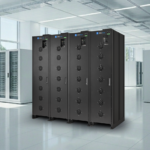
UPS battery cabinets can be populated before they even leave the factory, and can be shipped to a container manufacturer. This saves time on assembly and allows the containers to be shipped to the project site fully assembled.
“One of the drawbacks that is perceived of factory witness testing is that we have to ship all this equipment to one place, then when we’re done take it all apart, ship it to the site, and reinstall it,” Gary Russinko explains.
The ability to install all components in the container, test it, and then ship it tested to the project site avoids the traditional factory witness testing process, significantly reducing delivery timelines.
Transparency Between Suppliers and Customers
Data centers must have optimized and transparent inventory planning, as well as enhanced workflow processes. This ensures that all equipment is up to date and functioning properly, ensuring maximum efficiency and uptime. To ensure compatibility, teams should research and invest in components from reputable vendors and should factor future expansions into their purchasing plans to minimize disruption during upgrades and expansions.
Organizations should also ensure that their suppliers are adhering to industry standards and proactively managing risks in the supply chain. This includes evaluating components for quality and compatibility, verifying compliance with safety regulations, developing relationships with trusted vendors, and performing regular audits of suppliers.
The completed property features an expanded electric infrastructure to minimize downtime, optimize uptime, and maximize sustainability goals. The end result is a highly efficient, flexible data center that can support numerous applications with reliability and scalability. By taking these procurement steps, the teams at Corscale and KW Mission Critical ensured they were making smart investments in their supply chain management and created a more reliable system for their customer.

A reliable data center is essential to any organization’s success. ZincFive ensures all necessary steps are taken to create a secure and dependable UPS battery system. Future-proofing the supply chain is critical in an environment where the demand for data centers is growing exponentially.
The BC 2 – 500: Ultra-High-Rate UPS Battery Cabinet for AI and High Performance Computing
November 16, 2023

The new BC 2 – 500 is the ultimate blend of power, compactness, reliability, and sustainability
Data center operators are tasked with the ever-growing challenge of power density. Made even more prevalent by the rise in high performance computing (HPC) and artificial intelligence (AI), data centers are looking for opportunities to increase their power density while offering sustainable solutions to ESG-focused clients. To address the market need, we took the already compact, safe and sustainable BC 2 UPS battery cabinet design and filled it with more power.
The BC 2 – 500 now offers all these great benefits in an even smaller package. Customers focused on getting the most out of their power system now have a new option that can significantly reduce their footprint while increasing their power density by over 25%.
What’s new? The BC 2 – 500 is packed with ZincFive’s new Z5 13-90 USF battery and an optimized power path design that now offers a 25% smaller footprint than ZincFive’s standard BC 2 battery cabinet, which already led the industry with the smallest footprint per kilowatt and fewest cabinets per megawatt. This not only saves valuable space in the data center for revenue-generating equipment, but also provides even easier shipping, installation, and maintenance. With a 50% higher current carrying capacity, the BC 2 – 500 is not only capable of ultra-high-rate discharges but the inherent reliability of the NiZn chemistry powers it safely through even the toughest scenarios.
What’s the same? Within that meticulously optimized package and consistent form factor, you will find the same nickel-zinc batteries which have consistently provided top-tier reliability, power density, safety, and sustainability over the past decade. It also continues to be paired with an intelligent BMS system which allows for passive operation and no runtime interruptions. While retaining all the proven features that have made the standard BC 2 a customer favorite, our upgraded battery now enables us to provide a wider range of solutions for powering mission-critical environments.
The best is now even better: let’s look at what the latest BC 2 Cabinet options have to offer.
Packing Power into the Smallest Footprint in the Industry
In data centers, space is money. The smaller a UPS battery’s footprint, the more white space it frees up for the data center’s profit-making IT equipment, such as servers. With high performance computing and the continued race to develop and leverage machine learning the power required has significantly increased and will continue to do so. And since UPS batteries are arranged in rows, the battery cabinet’s width measurement matters most: narrow battery systems can pack more power capacity into the same row.
The BC 2 battery cabinet held the industry record for delivering the same amount of power as much larger lithium and lead-acid batteries, in the smallest package available. The BC 2 – 500 takes that to a new level. Leveraging ZincFive’s ultra-high-rate battery and a more robust power path, it will narrow an operator’s lineup by up to 25% vs. the standard BC 2 and up to 50% over typical lithium-ion battery options.
This battery cabinet delivers more power than a lead-acid battery cabinet twice its size. Lead acid batteries need 240” width, and lithium batteries need 153.5” width, to deliver 1250 kW of power. In contrast, BC 2 cabinets can deliver the same amount with only 84” of linear width.

Compared to the space lead-acid and lithium batteries take up in a data center, the BC 2’s tiny footprint gives operators multiple options. They can use the extra space to generate more profit by installing more servers and other IT equipment. They can select a higher capacity UPS system to fill the space a smaller unit would have. Or, especially in urban areas with expensive real estate, they can save money by developing a smaller data center footprint in the first place. These cabinets are also well-suited to modular data centers since operators can use shorter containers for them.
ZincFive batteries are not just smaller than their counterparts; they are also much lighter and more easily shipped. All the BC 2 cabinet options, which include both the battery and the BMS system, weigh just one third of a lead-acid system with the same power capacity. It’s much easier to transport, especially since the package ships fully complete and assembled. This reduces onsite installation time and the potential for human error.
More Reliable, Durable Backup Battery for Data Centers
Like the standard BC 2 Cabinet, the BC 2 – 500 offers high reliability backup batteries for the data center industry. This reliability stems from several characteristics of nickel-zinc batteries not shared by their lead-acid or lithium counterparts: the ability to pass current through depleted cells, higher current tolerance, and greater operating temperature range.
Each battery string supporting UPS applications contains hundreds of individual cells arranged in series. For example, typical lithium batteries each contain 136 cells per string, and valve-regulated lead acid (VRLA) batteries, 240 cells per string. If just one cell in either chemistry’s battery string fails, it can become a high impedance or an open circuit, which prevents the lithium or VRLA battery string from discharging power. One failed cell can result in the data center losing a critical load. Such an event can mean expensive emergency maintenance visits, or more frequent preventative maintenance visits to ensure all failed cells or batteries are replaced immediately.

In contrast, even a weak or depleted ZincFive NiZn cell can still pass current through its string safely. This keeps the battery string functional and avoids the need for an emergency maintenance call. Instead, one can simply replace the battery at the next routine maintenance check.
In addition, nickel-zinc batteries can operate at higher temperatures than most lithium or lead-acid batteries. While most lead-acid batteries require temperatures under 77°F (25°C) and lithium batteries under 86°F (30°C), nickel-zinc batteries can operate at ambient temperatures up to 95°F (35°C) and remain under warranty. Importantly, ZincFive nickel-zinc batteries have warranty terms that allow for temperature excursions of up to 122°F (50°C) for up to 5% of their operating life without violating the warranty. As data centers consider raising operating temperatures to ease cooling costs and increase sustainability, UPS systems with ZincFive NiZn batteries will provide higher reliability at lower costs.
A bonus for those in earthquake-prone areas: the BC 2 cabinet options are all seismic-rated with a robust seismic-tested design that makes it resistant to even severe earthquakes, boosting its reliability even further. A wide operating temperature range, coupled with inherent reliability at the cell level, makes nickel-zinc batteries like those in the BC 2 – 500 Cabinet some of the most reliable in the industry.
Attract Climate-Conscious Customers with Reduced Emissions
The growing urgency around climate change and pressure from stakeholders, policymakers, and the public has made sustainability a factor for data center customers as they choose their providers. Data center operators who can prove sustainability within their operations have an edge in attracting customers – and nickel-zinc batteries’ low climate impact helps provide that edge.
ZincFive’s nickel-zinc batteries have gone through a third-party climate impact analysis and show a significantly lower lifetime climate impact than that of lead-acid and lithium batteries. Their lifetime emissions are only a sixth of lithium batteries’ lifetime emissions, and only a quarter of lead acid batteries’. Sustainable production processes give them a carbon payback time – the time required for emissions savings from the product’s use to offset the GHG of its production – four times faster than that of lithium and lead-acid batteries.

Closing the Emissions Gap: Data Center Sustainability
Read PaperThe findings of this research allow data center customers to include often-elusive Scope 3 emissions reduction in their ESG reporting. By choosing the BC 2 battery cabinets, data center operators can gain a competitive advantage by showcasing their and their customers’ commitment to sustainability.
BC 2 – 500: The Complete Package
Our engineers designed the BC 2 cabinet to suit the needs of data center operators without compromising on any features. They’ve also designed an ultra-high-rate battery to address the surging demand for power density that accompanies the rapid growth of AI and HPC.
The BC 2 cabinet, in conjunction with the ultra-high-rate battery, results in the BC 2 – 500. With the smallest footprint in the industry, the BC 2 – 500 offers data centers the ability to maximize their white space and allocate it to more revenue-generating activities. It contains reliable UPS backup chemistry to ensure that critical loads are protected at all times, in any situation.
The cabinet’s sustainability advantages and minimal maintenance requirements make it an attractive choice for data center operators who are looking to reduce their carbon footprint and simplify their operations.
Building on the success of the standard BC 2, the BC 2 – 500 sets a new bar for the industry for years to come: delivering power whenever you need it, without compromise.
Introducing Z5 13-90: the Next Generation Ultra-High-Rate Nickel-Zinc Battery
November 7, 2023

In our modern, always-on electrified world, the demand for reliable and sustainable battery storage solutions is paramount to ensure the continued operation of critical facilities like data centers and other high power related applications. Nickel-zinc (NiZn) batteries are the welcome alternative to traditional energy storage technologies. NiZn batteries have proven themselves as the safe, powerful, and trustworthy choice for the future. Moreover, in an era where sustainability has become a top priority for major markets and corporations, nickel-zinc battery technology has established itself as a leading contender, challenging the dominance of its predecessors, lead-acid and lithium-ion batteries. This shift marks a significant transition towards a more sustainable and efficient energy storage landscape.

Today, ZincFive is introducing an upgraded and more powerful addition to our battery portfolio – the Z5 13-90. The Z5 13-90 battery unlocks greater potential for our customers, whether their focus is on maximizing power and footprint or on extending runtimes and energy capacity.
This ultra-high-rate battery, while maintaining the same case size as our previous generation, now delivers even greater energy and power, thanks to a boost in both amp-hour capacity and maximum current carrying capability. The Z5 13-90 uses the same NiZn chemistry that has been delivering best-in-class power density, as well as superior safety and sustainability, for over 10 years.
The energy and mission critical markets are constantly searching for ways to put more power, more computing, more energy, in a smaller footprint.
We’ve paid close attention to our customers’ input as well as industry trends and recognized that driving meaningful innovation in battery technology necessitated an increase in power density. With nickel-zinc’s stable and safe base chemistry, we confidently pushed beyond previous limits to help our customers advance. What the market really needed was greater amp-hour capacity in the same monobloc footprint. The Z5 13-90 ultra-high-rate battery offers our customers a 50% increase in maximum current throughput with no change in size or shape.

ZincFive will continue to manufacture both battery products: the Z5 13-80 and the Z5 13-90. Among them, the Z5 13-90 holds a distinctive position as one of the most power-dense monoblocs available in the market. This product is tailored to cater to the needs of customers who prioritize power density and space optimization. The availability of both battery products enhances the versatility of solutions we can offer to our valued customers.
Our customers can tap into more possibilities with the Z5 13-90 battery, whether they aim to maximize power and save space or extend runtimes and boost energy capacity.
Want to learn about our NiZn batteries, ZincFive created an explainer video that covers the advantages behind our remarkable chemistry. Discover the key factors that contribute to NiZn’s exceptional power, safety, reliability, and sustainability – qualities that render it an ideal technology for mission critical applications and beyond.