


Both new models are powered by a new ultra-high-rate monobloc battery from ZincFive – the Z5 13-90. This ultra-high-rate battery, while maintaining the same case size as its predecessor, now delivers even greater energy and power thanks to a boost in both amp-hour capacity and a remarkable 50% increase in maximum current carrying capability.
Tomorrow’s Growth, Today’s Challenges: The Next Frontier for Data Centers
March 15, 2024

The digital economy is growing – that’s indisputably good news. Developments in AI and growing compute power are creating room for new opportunities and innovations of all kinds.
This growth, however, hasn’t come easily. The global data center market is stretched to its limits. That doesn’t just mean that demand for capacity is outpacing supply. It also means that IT operators are left with overworked equipment, unable to replace it or acquire new equipment quickly enough – and that leads to critical system outages. In the worst-case scenarios, an overworked data center leads to risky scenarios.
While there have been bumps in the road, progress isn’t stopping. The demand for data center capacity remains robust, with hyperscalers – cloud titans like Amazon, Google, Meta and Microsoft – leading the way in greenfield deployments. Why are hyperscalers starting from scratch? First, existing infrastructure clearly can’t keep up with demand. Just as critically, hyperscalers have the resources and opportunity now to shape infrastructure to their needs, setting the stage for decades of innovation and economic growth.
Meeting capacity needs
Hyperscalers already operate approximately 900 data centers worldwide, Synergy Research Group reported earlier this year – accounting for about 37% of worldwide capacity. By contrast, just five years ago, nearly 60% of data center capacity was in on-premise facilities. In another five years, according to Synergy, overall capacity is expected to double, with hyperscalers claiming more than half of it.
By one estimate, the global data construction market should grow from $50.34 billion (as of 2022) to $73.43 billion by 2028. The buildout continues, even amid economic headwinds, global political uncertainty and continued supply chain challenges.
Broadly speaking, this growth continues thanks to the ever-expanding digital world. Commerce, communication and just about all facets of everyday life are increasingly digital. Major business sectors like healthcare, transportation and manufacturing continue to digitize their operations, demanding more data center capacity.
Meanwhile, the burgeoning possibilities of generative AI are driving demand for more processing power and more storage. Only about one year has passed since the release of OpenAI’s ChatGPT, yet according to one recent survey, 80% of chief data officers believe generative AI is likely to transform their organizations.

Powering the Future: Nickel-Zinc Batteries Unlock Data Centers AI Potential
Read MoreThe demand for greenfield facilities is also coming from organizations running workloads at the edge. Small yet mighty data centers are powering digital services for retailers, hospitals and countless other entities with distributed operations.
Agile, efficient, sustainable
Organizations pursuing greenfield projects aren’t just looking for more capacity. Along with more computing power, there’s a whole range of advanced capabilities that new data centers offer.
For one thing, the data centers of the future have to be exceptionally agile. Unlike the resources found in older facilities, new infrastructure can scale up and scale down as needed to meet the fluctuating requirements of modern workloads.
Additionally, new infrastructure can offer real-time monitoring and automated maintenance, helping IT administrators maintain seamless operations with less effort. The global data center automation market was valued at $7.6 billion in 2022, according to data from Grand View Research, and it’s expected to hit a whopping $20.9 billion by 2030.
Meanwhile, organizations are facing more and more pressure to build more sustainable data centers. That means building facilities with lower emissions and lower water usage. For instance, Google last year acknowledged that its data centers used 4.3 billion gallons of water in 2021. By Sept. 2023, the company was hyping new facilities (in the desert of Mesa, Arizona, no less) that use innovative air-cooling solutions to drastically cut back on its water usage.
Then there are advancements in battery technology that can help improve a facility’s power density – a key factor when you want to minimize a data center’s physical footprint while supporting power-hungry workloads.
Since their initial availability about a decade ago, data center designers have increasingly turned to lithium-ion batteries in lieu of lead-acid batteries. They’re more efficient – thus taking up less of the valuable floor space – and don’t have to be replaced as often as lead-acid. The downside is that lithium-ion batteries are relatively volatile, creating a greater risk of data center fires.
The latest battery technology, nickel-zinc batteries, takes up even less floor space than lithium. Additionally, while lithium-ion batteries offer high energy density, nickel-zinc batteries deliver high power density – meaning it has a higher power discharge rate. In a backup scenario, when the sole goal is to run a battery for just about five minutes, you want a small battery that can quickly discharge a large amount of power. This combination – a higher power discharge rate combined with a smaller footprint – will be key to the future of data centers.

Choosing the Right Battery for your Data Center
Read MoreMeanwhile, the nickel-zinc batteries developed by ZincFive aren’t volatile, like lead-acid and lithium-ion. In fact, it has no thermal runaway at the fundamental cell level and can operate at a wider temperature range. Nickel-zinc batteries also have an operating life up to 3x longer than that of lead-acid batteries, making them significantly more sustainable. All told, nickel-zinc batteries are safer, more reliable, longer lasting and offer a smaller footprint than the competition – and that amounts to a low total cost of ownership.
A better future for everyone
Building the data center of the future will take a great deal of innovation – traditional infrastructure and designs won’t cut it in tomorrow’s world. There will be greater demands for capacity and power, but budgetary realities will require an efficient use of space and more nimble operations. Meanwhile, political pressure and the realities of a warming planet will require safer, more efficient and more sustainable operations. The industry’s hyperscalers are already embarking on the massive projects that will set the standards for decades of digital infrastructure. Let’s hope they get it right.
Previously published by Data Center Post

Efficient and Flexible: The Power of Modular Construction in Data Centers
February 27, 2024

Driven by the need for increased efficiency, flexibility, and sustainability, the data center industry is pivoting to modular data centers. As modular construction becomes the new standard, facilities are under pressure to take full advantage of the benefits offered by this paradigm shift. Those who are late to embrace these advantages risk losing their edge to competitors in attracting customers, investors, and employees.
Modular vs. Traditional Data Centers: Understanding the Differences
Modular data centers are pre-fabricated, scalable units that can be easily assembled, modified, and reconfigured as needed. These units consist of standardized modules including power, cooling, and IT systems, which allow quick deployment and hassle-free expansion.
In contrast, traditional data centers are custom-built, fixed structures that require significant time, resources, and planning for construction and expansion. A recent survey of 228 data center executives found that over half had already deployed modular facilities, while 99% shared that they have plans to use modular data center designs in the coming years.

Designing for AI: Advancing Modular Builds to Accommodate Higher Demand
Read MoreThe Key Advantages: Efficiency and Scalability
Modular data centers’ inherent efficiency is one of their primary benefits. By using standardized components, operators can optimize modular data centers for specific power, cooling, and space requirements. These adaptations lower both operational costs and the amount of waste. From the beginning, modular data centers are easier to work with: they can be built off-site in a controlled, indoor environment, which reduces delays and eliminates weather concerns.
Modular data centers also offer unparalleled scalability. As a company’s IT needs grow, it can rapidly deploy additional modules without disrupting existing operations. This flexibility not only saves time and money, but also ensures that businesses can adapt to changing demands with minimal downtime.
Upgrading UPS Systems and Alternative Battery Chemistries
A critical component of any data center is the Uninterruptible Power Supply (UPS) system, which ensures continuous operation during power outages or fluctuations. Modular data centers provide a significant advantage when it comes to upgrading UPS systems, as they can easily accommodate alternative battery chemistries such as lithium-ion and nickel-zinc. These alternative chemistries offer higher power density, smaller footprints, lower weight, and faster recharge times compared to traditional lead-acid batteries.

Choosing the Right Battery for Your Data Center
Read MoreFor instance, nickel-zinc battery chemistries’ high power density allows operators to reduce the space (and associated costs) needed for backup power supplies. Some nickel-zinc UPS battery cabinets can deliver the same power as lead-acid battery cabinets twice their size and weight, which significantly reduces the number of cabinets required and the linear size of the overall container. Nickel-zinc batteries can also operate at higher temperatures, which enables a lower-capacity cooling system with lower up-front and operating costs. Since they can’t go into thermal runaway, nickel-zinc batteries don’t need the additional safety infrastructure that lithium-ion batteries require – making them ideal for modular data centers.
Environmental Impact and Sustainability: The Green Benefits of Modular Data Centers
Increased demands for scope 3 emissions transparency are gaining momentum, driven by pressure from investors, regulators and the general public. Data centers that stay ahead of the competition in reporting and addressing scope 3 emissions will attract customers and investors who are seeking comprehensive disclosure and commitments to sustainability. This applies to the climate impact of both the data center companies and their customers (as happens with colocation facilities).
Modular data centers have a significantly smaller environmental footprint compared to traditional data centers. Due to their scalable nature, modular data centers can be tailored to meet specific energy requirements, resulting in reduced energy consumption and lower greenhouse gas emissions. They can be also easily upgraded to incorporate technologies with lower environmental footprints, such as the previously discussed sustaimable batteries for UPS systems.

Why Modular Data Centers are Good for the Environment
Read MoreThe Bottom Line: Embracing the Future of Data Center Infrastructure
With greater efficiency, scalability, flexibility, and sustainability, modular data centers are the new norm for data center infrastructure. As the demand for data storage and processing grows, savvy enterprises will recognize and act on the benefits of adopting modular data center solutions to remain competitive, reduce costs, and minimize their environmental impact. By not only adopting modular construction, but fully embracing its advantages, businesses can ensure that they are well-equipped to adapt to the ever-changing technological landscape while contributing to a greener, more sustainable future.
Previously published by Digitalisation World
How to achieve sustainable data center backup systems
February 26, 2024

Data center reliability and resilience are non-negotiable. These facilities, which house vital digital assets and support critical business operations, must maintain high uptime to meet the demands of an increasingly connected world.
At the heart of this reliability is the center’s uninterruptible power supply (UPS) system, which ensures consistent power flow and protects against potentially catastrophic downtime.
A UPS system failure can lead to significant financial losses, damage to equipment, loss of data, and erosion of customer trust. According to the Uptime Institute, more than two-thirds of all outages cost data centers over $100,000.
Backup power systems have another increasingly urgent imperative: sustainability. Investors, customers, and regulators are exerting pressure on industries, including the data center sector, to adopt environmentally friendly practices and ultimately achieve net zero GHG emissions.
The failure to embrace sustainability carries risks that extend beyond environmental harm. Reputational damage, regulatory penalties, and loss of business from eco-conscious clients can all impact the bottom line.
Conversely, the adoption of sustainable practices can enhance a company’s reputation, attract investment, and provide a competitive edge in an increasingly green market. Sustainable UPS systems can help data centers achieve these goals by reducing their environmental impact.

Choosing the Right Battery for your Data Center
Read MoreSo how can UPS systems be made more sustainable? One key lies in the choice of batteries used in these systems. Traditional UPS systems often rely on valve-regulated lead-acid (VRLA) batteries.
While these technologies have long been considered a standard, alternative battery chemistries can offer a path to more sustainable UPS systems, taking into consideration a variety of characteristics:
Material use: The materials used in different battery chemistries vary in their lifecycle environmental impact. For instance, nickel and zinc are safe and abundant materials that mitigate battery hazards, health risks, and scarcity concerns compared to the lead and lithium used in lead-acid and lithium batteries. This advantage carries through to the end of the battery lifecycle; recycling nickel and zinc batteries uses less energy than lead, which requires energy-intensive high heat smelting.
Greenhouse gas (GHG) emissions: The production, use, and disposal of batteries all contribute to GHG emissions, which drive climate change. Certain battery chemistries and designs, such as nickel-zinc batteries, have a lower manufacturing carbon footprint than other battery types. They’re also energy-efficient with a long lifespan, further reducing these emissions.
Carbon payback time: This is the time it takes for a product to ‘pay back’ the carbon emitted during its production through its operational life. A shorter carbon payback time means the product used less carbon in its manufacture and is more beneficial for the environment.
Volatile organic compounds (VOCs): VOCs are often used during the production of batteries and can contribute to air pollution and health problems. Batteries that minimize the use of VOCs in their production processes are more sustainable.
Water footprint: This refers to the total volume of freshwater used to produce a product. Battery manufacturing can be water-intensive, so choosing batteries that prioritize water efficiency in their manufacturing processes contributes to their sustainability.
Energy footprint: This is the total energy consumed over a product’s lifecycle, including its manufacturing process. The less energy used over the battery’s lifecycle, the lower its energy footprint and the more environmentally friendly it is.
These characteristics play a crucial role in determining the sustainability of UPS batteries in data centers. By understanding these factors, data center operators can make informed choices that favor sustainability, reducing their environmental impact while maintaining reliable power supply.
For instance, nickel-zinc (NiZn) batteries fulfill all these requirements by using abundant raw materials with a low carbon manufacturing footprint, yielding a shorter carbon payback time than lead-acid and lithium-ion batteries.
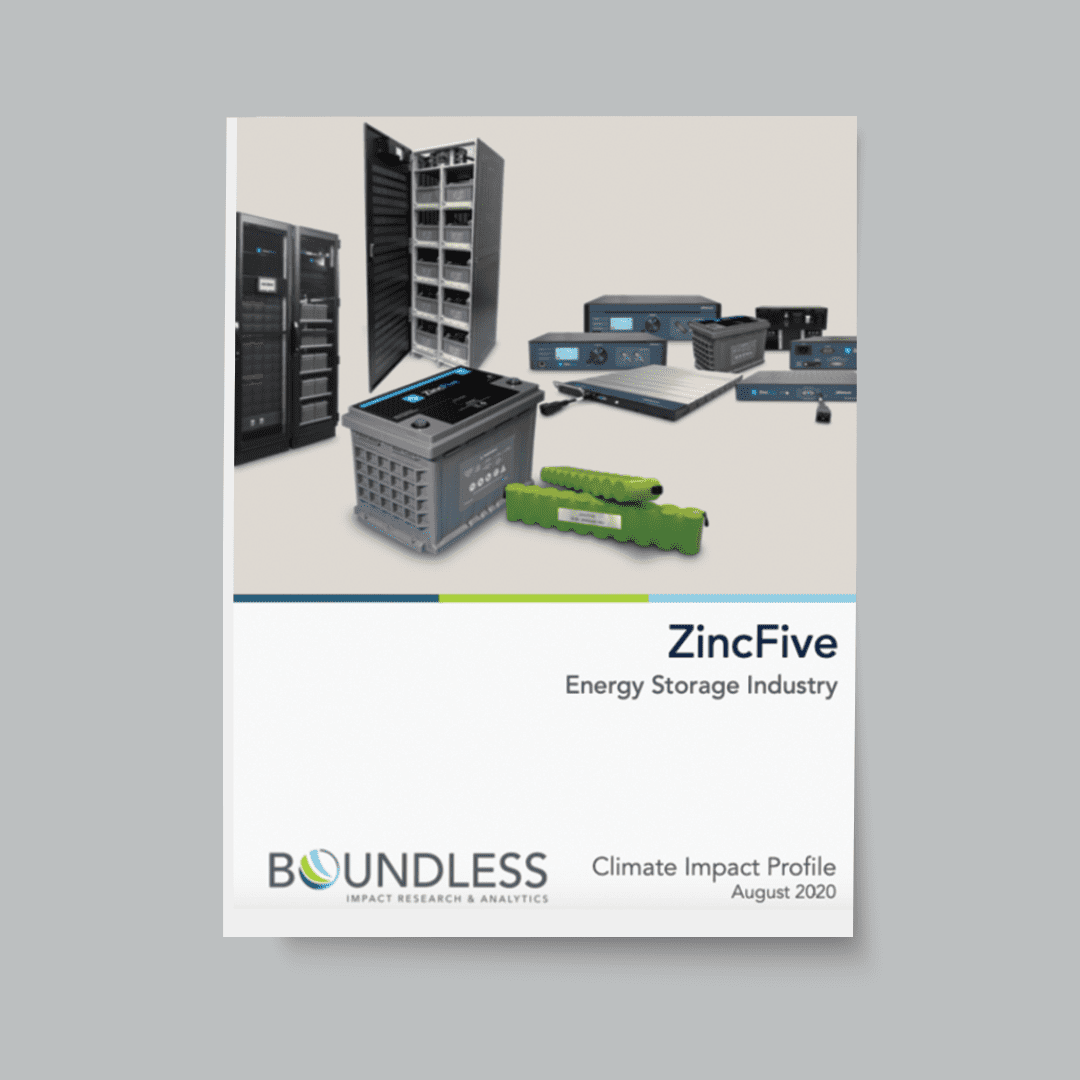
Nickel-Zinc Climate Impact Profile
Read MoreOver their lifetime, nickel-zinc batteries use 95 percent less water than lithium batteries, and 22-33 percent less energy than lithium-ion and lead batteries.
Data center operators including Corscale and Wyoming Hyperscale have chosen to utilize NiZn-powered UPS systems for their facilities, driven in large part by their sustainability metrics.
According to Boundless Impact Research and Analytics’ analysis, nickel-zinc batteries have achieved the highest climate rating of 9.4 out of 10, making them an ideal option for data centers looking to reduce their scope 3 emissions and reach their sustainability goals.
Considering sustainability when implementing resilience strategies is not just good for the environment – it’s good for business. Environmental responsibility is becoming a necessity rather than a choice.
By choosing sustainable UPS energy storage systems, data centers can improve their environmental performance, meet growing stakeholder expectations, and ensure their operations remain resilient and reliable.
Previously published by Data Center Dynamics.

Designing for AI: Advancing Modular Builds to Accommodate Higher Demand
February 6, 2024

“Modular design has taken off in the past decade – but the demands of AI and machine learning mean we need to innovate even faster for smarter, more sustainable data centers,” declared ZincFive’s Director of Product Management Aaron Schott as he kicked off an insightful panel at the recent 7×24 Exchange Conference. Aaron and data center experts from Skybox Data Centers, Integra Mission Critical, and Telios Engineering explored how cutting-edge designs for modular data centers can power sustainable growth amid surging demand.
As data centers face escalating power needs driven by AI and numerous other emerging technologies, rack densities continue to climb and force data center operators to adjust. Luckily, modular data centers are perfectly positioned for such adjustments.
Modular data centers are a design approach in which prefabricated units are assembled and outfitted with preselected, preconfigured equipment. This approach allows more flexibility in location and timing, and easier as-needed scaling and replacement of the center’s equipment and systems over time – perfect for the ever-shifting needs of data centers. Additionally, modular design also supports sustainable construction and operation of a data center.
Density Strains Traditional Designs
The panel began by discussing one of the biggest new challenges for modular data centers: the sheer amount of data needed for burgeoning applications such as generative AI.
You have these large, large demands. New chips drive densities beyond what’s been cooled before – or even considered possible.”
Gordon Kellerman, Skybox Data Centers
While modular designs are inherently more flexible than traditional data center designs, they must adapt even further to sustainably support spiking compute power needs. Megawatt demands from users are increasing yearly. Gordon noted how “in the past, a 1 MW deal was great; now, many customers require 150-300 MW and beyond.”
Cooling Innovations Accommodate Capacity and Lower Footprint
Greg MacNeill of Integra Mission Critical offered cooling techniques, such as immersion cooling, as examples of ways data centers are meeting this skyrocketing compute density demand without exceeding budgets and sacrificing sustainability goals.
“As densities increase, I recommend planning a facility evolution to fluid cooling,” Greg shared. “A planned shift to integrate more powerful cooling strategies can help prevent rip-and-replace retrofitting down the line, helping future-proof modular data centers for rising density.”
More powerful cooling strategies allow data centers to reduce their shell size by 15-20 percent. By packing more equipment into modular power and cooling yards, over 35% more capacity fits in less land. This smaller physical footprint is both more sustainable, and more cost-effective in terms of real estate costs. Ambient cooling solutions can also deliver major infrastructure savings.
“The time is now to consider hybrid environments that combine air and liquid cooling,” agreed Gordon. “Immersion cooling enables massive space savings compared to traditional cooling strategies.”
Mason McPike of Telios Engineering also supported these techniques and suggested incorporating modular electrical rings underneath facilities to enable easy future cooling expansions, since “modular power infrastructure enables component replacement without full shutdowns.”
Why Modular Data Centers are Good for the Environment
Read PostBuilding on Mason’s point, Greg McNeil added how “modular design lets us phase in infrastructure as the facility grows. Designing for scalability is more sustainable, since growing the data center won’t result in discarded materials from reconstruction.”
Modular power rooms enable flexible equipment deployment, and allow for renewable energy connections anywhere.
Enhancing Resiliency and Sustainability Despite Demand
While meeting data demand is paramount for data centers, the ability to do so without sacrificing resiliency and sustainability will set successful data centers apart. Investor pressure to disclose scope 3 emissions is growing, and as companies look to reduce their emissions, data centers are increasingly under the microscope as an opportunity for impactful reductions, considering they are one of the most energy-intensive components of their customers’ supply chains.
Meanwhile, the cost of data center outages is rising, with a quarter of data center operators responding to an Uptime Institute survey stating that their most recent downtime incident cost them over one million dollars in both direct and indirect costs.
Aaron Schott explained that backup battery innovations like ZincFive’s nickel-zinc battery cabinets help data centers simultaneously increase server space, meet resiliency goals, and improve sustainability.
Sustainable Backup Power with Uncompromised Safety and Reliability
Read PostNickel-zinc batteries have the highest power density on the market, which frees up valuable real estate for data centers by allowing them to pack the same runtime capacity into a significantly smaller space than lead-acid or lithium-ion solutions. Their 15-20-year lifespan is double that of lead-acid batteries, which reduces replacement needs and costs. And since they’re incapable of thermal runaway, they don’t need the same bulky safety equipment that lithium-ion batteries need to protect from fire hazards.
Nickel-zinc batteries also provide greater resiliency against power failures and shutdowns, which can cost data servers hundreds of thousands per event. Nickel-zinc battery cells allow full conductivity even when depleted, which guards against the string failure and emergency maintenance visits that lead-acid and lithium-ion batteries can require.
Greg MacNeill added that nickel-zinc batteries’ resilience against heat can help data centers save on costs and energy as well.
We’re always exploring innovations across electrical systems, including pushing for increased operating temperatures, that help data centers save energy and cooling costs. For a long time, backup batteries limited data centers to lower temperatures to avoid lead-acid and lithium battery failure. By removing that constraint, new chemistries like nickel-zinc allow us to operate at higher temperatures and save energy.”
Greg MacNeil, Integra Mission Critical
Collaboration Is Key
As Gordon Kellerman of Skybox Data Centers stated, collaborating across manufacturers, operators, and clients is key going forward. Innovations like immersion cooling and nickel-zinc batteries boost efficiency, resiliency, and energy savings.
The panelists all concluded that reaching the next level of high-density, high-efficiency modular data centers requires partnership and optimization. By collaborating across data center operators, manufacturers, integrators, and consultants to integrate expertise while optimizing components like nickel-zinc batteries for reliability and sustainability, modular innovation can achieve unprecedented new heights.
Sustainable Backup Power with Uncompromised Safety and Reliability
January 4, 2024

As AI becomes mainstream, rack server density demands are increasing more than ever before – just as growing climate awareness is putting pressure on data centers to become more sustainable. How can operators balance all these challenges without compromising uptime?
ZincFive’s Aaron Schott joined Carsten Baumann, the Director of Strategic Initiatives of Schneider Electric, and Alex Dickins of Datacenter Dynamics (DCD), to discuss this very question in the DCD event, “Choosing sustainable backup power without compromising on safety & reliability.” They dove into solutions that can help data centers both provide reliable increased server rack density and meet sustainability goals.
Listen to the entire session to explore how robust battery solutions can allow data centers to navigate market pressures to advance towards net-zero, and read on for our chief insights and takeaways:
Sustainability Is a Top Priority for Data Center Customers
The data center industry is confronting a sustainability imperative as capacity expands rapidly. Currently, data centers consume around 2% of global energy demand.
By 2040, just 16 years from now, global data center capacity will double. If we double capacity, this becomes a bigger portion, so creating a more sustainable data center is critical.”
Schneider Electric’s Carsten Baumann
In response, leading companies, including Schneider Electric, are evaluating their entire supply chain and product lifecycles. Baumann disclosed that in 2022, over 99% of Schneider Electric’s 61 million tonnes of emissions stemmed from scope three, or supply chain, emissions. In response, they initiated a Zero Carbon Project with their top thousand suppliers, encouraging them to review and reduce emissions by 50% by 2025 for Schneider Electric to continue sourcing from them. Such initiatives indicate that large clients are seeking ESG-conscious suppliers – including data centers – that can prove lower emissions.
Standard ISO sustainability metrics are also emerging to drive improvements. “Having an internationally standardized framework to measure against is very valuable, since we can evaluate suppliers based on the same consistent ISO standards,” said Baumann.
If we make sustainability metrics easy and standardized, data centers will optimize and compete to be the most sustainable, and quickly move the industry forward.”
ZincFive’s Aaron Schott
Nickel-Zinc Batteries Can Help Quantify Sustainability from Cradle to Grave
One area in which data centers can prove greater sustainability to clients lies in their UPS battery sourcing. For instance, Baumann noted that while lead-acid and lithium batteries rely on materials with limited supply chains and intensive, controversial mining practices (including cobalt and lithium), ZincFive batteries rely on abundant metals like nickel and zinc.
Schott added that ZincFive batteries score well – literally – across their full lifetime environmental impact, from sourcing to manufacturing to deployment. A third-party study analyzed ZincFive batteries’ climate impact metrics, including greenhouse gas production, water usage in manufacturing, volatile organic compounds, and other sustainability factors. He pointed out that, with 10 representing the highest positive environmental impact, ZincFive’s NiZn batteries scored a 9.4 – significantly higher than lead-acid and lithium-ion batteries.

Closing the Emissions Gap: Data Center Sustainability
Read MoreMore Than Sustainable: Reliable and Space-Efficient
Of course, sustainability isn’t the only priority for data centers considering UPS solutions. To be competitive, batteries must also address other concerns as well: safety, reliability, and – as data centers try to pack more capacity to support growing client needs – efficient use of space.
Fortunately, nickel-zinc batteries specialize in those areas too. Nickel-zinc chemistry enables power-dense designs, which enables fewer, smaller cabinets and footprint – bolstering sustainability while maintaining backup time.
“As data centers scale up with 1.5-2MW+ UPS units, we increased battery power density in our recently expanded BC 2 battery cabinet line,” Schott shared. “This reduces their installation size while continuing to support growing UPS power. With increased cabinet power density, our footprint can now be 50% of lithium-ion batteries’, which is already 40-50% less than lead acid.”

“Safe Enough” is not Safe: Assessing Battery Tradeoffs in Data Centers
Read MoreThese higher-density designs reduce batteries’ data center footprint, materials, and costs all at once. As facilities grow larger, examining aspects to cut size helps greatly. “For a 100MW facility with 50 modular UPS buildings, even stacked for space efficiency – if we can shrink each one by a foot, we save substantial materials,” shared Schott.
Nickel-zinc batteries are not only incapable of thermal runaway, but can also reliably operate at higher temperatures than lead-acid and lithium batteries – reducing cooling costs. “It’s advantageous to design data centers to safely run hotter without warranty concerns,” said Schott. “This efficiency gained from higher battery operating temperatures enables more free cooling.”
One consideration for data centers when choosing batteries is that UPS batteries generally only need to operate for a few minutes at a time. Aaron recommended matching higher power density batteries to this shorter runtime need. This helps them meet runtime needs with fewer cabinets, preventing oversized solutions and improving efficiency.
Holistic Metrics Show the Way to Net Zero
All three panelists agreed that achieving more sustainable data centers requires a holistic approach.
We need to address the sustainability challenge collectively across disciplines – batteries, UPS, cement, steel, IT equipment, etc. Looking at all these components can get us closer to net zero data centers,” said Baumann. “Collectively we’re setting data center baselines now. Once established, we can make incremental improvements towards a net zero future.”
Schneider Electric’s Carsten Baumann
2023 Highlights: Product Launches, Partnerships and Good Chemistry
December 21, 2023

Across the data center industry, 2023 brought sustainable backup power solutions into the spotlight. Industry-wide conversations and events placed renewed priority on technologies that balance safety, cost efficiencies, and environmental impact. As the effects of climate change become more severe, milestones from COP28 to rising private sector commitments gave momentum to accelerate the adoption of cleaner, safer backup capacity.
As 2023 comes to a close, we want to take this opportunity to highlight ZincFive’s major achievements, milestones, and collaborations that made the year such a success!
Breakthrough Products Offer Unmatched Power Density
This year, we proudly launched two new product offerings within the BC Series UPS Battery Cabinet lineup: the BC 2 – 500 and the BC 2 – 300X. We also announced a new ultra-high-rate battery, the Z5 13-90, which will power the new battery cabinet models.
The latest BC 2 – 500 and BC 2 – 300X products demonstrate our unwavering commitment to delivering the most compact footprint per kilowatt, showcasing consistent advancements with each new release, and surpassing the already industry-leading footprint of ZincFive’s original BC 2 battery cabinet.

We also expanded our presence in the electric vehicle (EV) charging and microgrid markets through our EV Charging solution collaborations with Kaizen Clean Energy (KCE) and Advanced Power & Energy (AP&E).
Joining Forces with Industry Leaders
This year cemented ZincFive’s status as the go-to provider for sustainable backup power solutions as we formed major partnerships with globally recognized leaders across critical industries. In October, electrification and automation technology leader ABB added ZincFive as an approved supplier, allowing ABB to deliver UPS systems that include safe, green ZincFive NiZn battery solutions.

ZincFive and ABB Work Together to Bring Safe, Sustainable Energy Storage to the Data Center UPS Market
Read MoreZincFive also signed an agreement to license our nickel-zinc-based UPS technology to Econolite, part of Umovity and the leader in One-Stop-Shop advanced traffic management solutions. Econolite will have worldwide rights to manufacture, sell, and service ZincFive’s industry-leading nickel-zinc based UPS technology to the intelligent transportation market. This global reach will use our safe, reliable, and sustainable technology to improve mobility worldwide
Industry Awards Honor Pioneering Innovation
This year, we were honored to have our technology, innovations and sustainability leadership recognized by awards from Mission Critical Magazine and S&P Global. We won the 2023 Mission Critical Magazine Top Tier Product Award in the UPS Systems category for our BC 2 UPS Battery Cabinet. The BC 2 Battery Cabinet was selected for the unparalleled power density, reliability, industry-leading footprint, and unmatched safety it offers in UPS applications for data centers and other mission-critical environments.

ZincFive Wins Mission Critical 2023 Top Tier Product Award in the UPS Category
Read MoreWe were also named a finalist for the S&P Global 2023 Platts Global Energy Awards, with our BC Series Battery Cabinets competing for the title of Commercial Technology of the Year. As we continue our work to pioneer safer, cleaner backup power solutions, accolades like these validate our progress and push us to keep raising the bar to realize our vision of a more sustainable future.
Growth
This year, we announced a strategic partnership with Orion Infrastructure Capital (OIC). The capital investment will provide ZincFive up to $80 million via a term loan to fuel the company’s global commercial adoption in existing and new markets, including mission-critical applications in data centers, industrial engine starting, and other high-power energy storage markets. This collaboration will accelerate global channel development, advance the company’s new product pipeline, and expedite the establishment of US-based high-volume production capacity to meet customer demand.

ZincFive Closes an $80 Million Capital Partnership with Orion Infrastructure Capital
Read MoreZincFive also expanded in two ways: geographically into Europe, and as a team ending the year with many more faces than it began! We’re thrilled to have added so many talented, enthusiastic professionals to our mission this year. We’re growing fast – if you’re interested in an exciting career that helps make the world more sustainable, check out our open positions. Watch what our team has to say about life at ZincFive!
In conclusion, 2023 was an incredible year for ZincFive, and we couldn’t have done it without support from our partners, customers, and of course, our growing team. This is a testament to the Power of Good Chemistry, and we can’t wait to see what 2024 holds!
How ABB and Their Customers Future-Proof Construction Supply Chain with NiZn Technology
November 27, 2023
A key challenge in the data center environment is the need to future-proof and scale operations. As organizations strive to remain at the cutting edge of technology, having a comprehensive plan for procurement helps ensure that their supply chains can meet current and future demand.

Strengthening this process was crucial for Corscale Data Centers and KW Mission Critical Engineering, who partnered with ZincFive and ABB to bring a data center in Northern Virginia to completion. This project was discussed in detail during a panel at the 7×24 Spring 2023 Conference, moderated by Harry Handlin, ABB U.S. Data Center Manager. The discussion featured Aaron Schott, Director of Product Management of Data Center Solutions at ZincFive, Nic Bustamante, Chief Technology Officer at Corescale, and Gary Russinko, Managing Pricipal at KW Mission Critical Engineering.
Corscale’s main project goal was to focus on improving sustainability, which becomes even more of a challenge when supply chains are constrained.
The project is a five-building campus providing 300-400 megawatts on a 130-acre property. The data center was designed to use modular equipment for generators and UPS rooms in order to have flexibility in their function, which would allow the data center to rapidly scale its capacity and services in order to meet any changes in customer demands. Corscale chose ZincFive’s nickel-zinc batteries for their impressive sustainability benefits in addition to reliability and unparalleled safety.
Why Data Center Operators Prefer Nickel-Zinc Batteries
Procurement is an important step in navigating supply chain challenges, as organizations must source components that are aligned with their project goals and are reliable and compatible with their existing infrastructure, without compromising project timelines. Circularity was a common theme of this project, in terms of the design, equipment, and use of materials. ZincFive’s nickel-zinc batteries use materials that are more commonly sourced from the Earth and do not use conflict minerals.
At the scale that Corescale plays at, circularity becomes a central theme for us. Looking at ZincFive, we’re using materials that are far more common in the Earth, designing a battery that in itself is easy to recycle. The fact that the product also lasts longer for us means that the life cycle model gets much better for us.
Nic Bustamante, Chief Technology Officer at Corescale
The teams looked into ways to reduce waste and optimize processes throughout the supply chain. ZincFive’s batteries have higher recyclability, and longer life cycles, which are favorable features for operators to minimize maintenance times. They also weigh less, which makes it easier to transport via roadways, and they are safe for air freight. In this case, Nic Bustamante explains one of the most important characteristics of nickel-zinc batteries:
“A big thing for customers is that [NiZn batteries] fail closed. Which I think is something people don’t talk about enough; almost all batteries fail open, so we love that.”
Failing closed allows other batteries in the cell to continue to discharge. This poses the question: what do data centers really need? To make sure their batteries can sustain high currents, safely, reliably, and consistently for long periods of time.
The inherent safety of ZincFive’s battery technology provides an additional layer of flexibility during the construction phase.
That’s the neat thing about having a chemistry that is inherently safe. You can take the chemistry and design it for maximum output power and push the limits of what batteries can do.
Aaron Schott, Director of Product Management at ZincFive
UPS battery cabinets can be populated before they even leave the factory, and can be shipped to a container manufacturer. This saves time on assembly and allows the containers to be shipped to the project site fully assembled.
“One of the drawbacks that is perceived of factory witness testing is that we have to ship all this equipment to one place, then when we’re done take it all apart, ship it to the site, and reinstall it,” Gary Russinko explains.
The ability to install all components in the container, test it, and then ship it tested to the project site avoids the traditional factory witness testing process, significantly reducing delivery timelines.
Transparency Between Suppliers and Customers
Data centers must have optimized and transparent inventory planning, as well as enhanced workflow processes. This ensures that all equipment is up to date and functioning properly, ensuring maximum efficiency and uptime. To ensure compatibility, teams should research and invest in components from reputable vendors and should factor future expansions into their purchasing plans to minimize disruption during upgrades and expansions.
Organizations should also ensure that their suppliers are adhering to industry standards and proactively managing risks in the supply chain. This includes evaluating components for quality and compatibility, verifying compliance with safety regulations, developing relationships with trusted vendors, and performing regular audits of suppliers.
The completed property features an expanded electric infrastructure to minimize downtime, optimize uptime, and maximize sustainability goals. The end result is a highly efficient, flexible data center that can support numerous applications with reliability and scalability. By taking these procurement steps, the teams at Corscale and KW Mission Critical ensured they were making smart investments in their supply chain management and created a more reliable system for their customer.

A reliable data center is essential to any organization’s success. ZincFive ensures all necessary steps are taken to create a secure and dependable UPS battery system. Future-proofing the supply chain is critical in an environment where the demand for data centers is growing exponentially.
Power vs. Energy: How to Make the Right Battery Choice for Your Application
October 30, 2023

Batteries are the unsung heroes of the clean energy and electrification transition. They store energy from renewable sources, such as wind and solar, to ensure a steady power supply whenever it’s most needed – no matter the weather or time of day. The transition to sustainable transportation also relies on batteries to power both EVs and EV charging stations. As multiple industries including buildings, transportation, electric grids, and data centers exponentially increase electricity demands, the question rises: which battery type is best?
There’s no one answer, because each battery chemistry has different strengths and weaknesses. By choosing the best-fit battery for each application, users can optimize the performance, cost effectiveness, and reliability of their power backup and energy storage systems.
Different rechargeable battery chemistries – such as lead-acid, lithium-ion, and nickel-zinc – are best suited to their own particular use cases. As the incumbent technology in many applications, lead-acid batteries often provide a sense of familiarity and security in addition to cheap prices. While they continue to have their place in energy storage, it’s worth looking into alternative options for applications that require significant energy or power density. For these specific needs, newer chemistries offer benefits including higher performance, longer lifespan, and greater reliability.
Energy Batteries for Long-Duration Needs
For instance, transitioning to cleaner transportation relies greatly on electric vehicle (EV) adoption. EVs demand energy density from their batteries: they must store and steadily release a supply of energy for prolonged periods, while being lightweight enough for cars to carry them easily. With a relatively low weight and high energy density, lithium-ion batteries serve long-discharge needs and thus excel in EV transportation applications.
Large-scale renewable energy storage is another ideal application for energy batteries such as lithium since the grid’s ongoing energy demands often require several hours of sustained energy release. These needs prioritize the duration of energy being provided, even if the discharge rate is moderate to low.
Power Batteries for Short-Duration Services
Other applications require batteries with high power density. Rather than supplying energy over a longer period of time, batteries with high power density supply vast amounts of power for relatively short periods of time – for instance, when a data center needs backup power to maintain its processing capability and preserve reams of highly valuable and sensitive information from outages.
In the context of Uninterruptible Power Supply (UPS) systems, lithium-ion batteries perform adequately – but it’s not their forte. While they’re energy-dense, they aren’t as power-dense as other options. For example, to house enough lithium batteries to power a data center for even a few minutes, operators need to use up valuable space and spend more to get enough batteries for the job. Lithium-ion batteries are also prone to thermal runaway and require special fireproofing equipment, making them more complex and expensive to install. They do best in cars and phones, not data centers.

Improving Data Center Profits with Compact and Safe NiZn Backup Batteries
Read PostThese UPS applications require impressive amounts of battery power – but only for a few minutes, until the backup generators come online. Here’s where nickel-zinc battery chemistries shine. With a significantly smaller footprint per kW than lithium and lead-acid batteries, nickel-zinc batteries provide the same amount of power as lead-acid batteries up to twice their size. This allows data centers to save valuable space for servers while storing the vast power needed to safeguard their data.
Similarly, batteries are used to start generators that help power major operations, especially for backup power. According to Cummins Power Generation, “weak or undercharged starting batteries are the most common cause of standby power system failures.” Uptime Institute’s analysis notes that the single biggest cause of power incidents is failures to these standby power systems. Gensets don’t require prolonged periods of battery operation, as they only need power for the short time it takes to start the generators. As a result, the application’s priorities are reliability and a high discharge rate, at which power batteries such as nickel-zinc excel.
Some of the most challenging and significant battery system return-on-investment applications also require megawatts of power for mere seconds — even milliseconds. Numerous industrial and safety-related systems require this type of immediate power. Power batteries such as nickel-zinc are an environmentally and financially attractive alternative to running expensive generators and using utility power to support short-duration power bursts.
Hybrid Battery Approach for the Best of Both Worlds
To power microgrids and provide grid storage, operators can take advantage of multiple battery types. Lithium-ion batteries provide endurance for long-duration capacity needs, while nickel-zinc batteries’ power density can handle peak demand times at a lower infrastructure cost. Balancing the load between both chemistries enhances the grid’s efficiency in managing renewable energy resources. For data centers, this is a growing segment as customers look to supplement the grid, provide frequency regulation or peak shaving, while also maintaining their UPS backup runtime. A combination of power and energy where two chemistries can combine to give the data center operator the best of both worlds.
Choosing the Right Battery for Your Data Center
Read PostThe same hybrid principle applies to EV charging stations. Lithium-ion batteries can meet lower-power charging needs, while nickel-zinc batteries facilitate rapid high-power top-ups as fast charging becomes more prevalent. Including both in a charging station combines the strengths of each to optimize the charging experience.
In conclusion, now that the market offers numerous battery chemistries, securing an energy-resilient future relies on selecting the right battery for each application. While no single battery chemistry can fulfill all requirements, users can optimize their systems with the best fit for each use. The future of energy storage relies on a clever combination of numerous battery types to ensure reliable, sustainable energy across industries – no matter what.
Previously published with Data Center Frontier
Powering the Future: Nickel-Zinc Batteries Unlock Data Centers’ AI Potential
October 23, 2023

At this point, most people have heard of AI’s breathtaking potential via ChatGPT, industrial applications, and more. But data centers are looking under the hood of these shiny new features and finding the lesser-known truth: AI’s power demands are equally breathtaking.
As data centers face escalating power needs driven by AI and numerous other emerging technologies, rack densities continue to climb and force data center operators to rethink their battery backup strategies. Rather than relying on familiar but less powerful lead-acid batteries to back up increasingly vast applications and power, they’re turning to new chemistries that better balance resiliency, reliability, footprint, and sustainability under intensifying demands.
At this year’s Data Center Dynamics (DCD) Towards Net Zero virtual discussion, ZincFive’s Director of Product Management, Aaron Schott, joined Harry Handlin, Data Center Segment Leader at ABB, and Dave Buckner, Director of Engineering at Sabey Data Centers, in a panel moderated by DCD’s CTO Steven Warren to discuss guidance on data center power innovations, emerging trends, battery options, and strategies to meet intensifying capacity needs sustainably.
You can watch the full presentation for additional insights; meanwhile, we’ve summarized below the key takeaways from the discussion on optimizing data center power to meet future demand.
What’s Happening Now: Surging Densities Strain Existing Strategies
Many data centers are struggling to support the high-powered computing capabilities required by AI and machine learning applications. AI is driving demands for higher rack densities as data centers pack more compute power into servers. This additional need for power translates to the need for more powerful backup power systems, including uninterruptible power supply (UPS) equipment.
“We’re seeing a need for more powerful UPS modules, up to 1.5 megawatts, to support these densified racks,” notes Harry Hamlin, the data center segment manager at ABB. “This strains data centers’ space and power limits.”
Harry went on to note how some batteries used for UPS systems are unable to keep up with evolving demands.
Lead-acid systems have a relatively low power density, so they become impractical at such large UPS capacities. While lithium-ion batteries have been the primary alternative until now, they have supply chain, safety, and regulation issues. Some jurisdictions prohibit lithium batteries entirely, and at ABB we anticipate lithium costs rising substantially in the future given the enormous demand from energy storage and transportation electrification.
Harry Handlin, Data Center Segment Manager at ABB
Harry shared that, at ABB, he’s been leading research into more sustainable, cost-effective battery solutions for the AI era.
How to Optimize Backup Power with the Right Battery Chemistries
The panel agreed that data centers can optimize resiliency and sustainability by selecting targeted battery solutions for their ideal use cases. In particular, Harry said that nickel-zinc batteries offer distinct advantages for space-pressed data centers running intensive workloads. Their unmatched power density provides the same runtime capacity in significantly less space than lead-acid or lithium-ion options, freeing up precious data center real estate.
Nickel-zinc is a great product because of its circularity, cost, and sustainability benefits. Most of our customers see nickel-zinc as a no-brainer when evaluating total cost of ownership and return on investment.
Having the rack assembled with nickel zinc, instead of assembling on site as with other technologies, saves significantly on labor. They can also operate at higher temperatures than other batteries – up to 35°C / 95°F – which helps reduce cooling costs and related emissions.
We’re adopting nickel-zinc technology in our facilities. It offers at least twice the life of traditional lead-acid batteries. Getting ZincFive systems energized faster through prefab shipping and installation puts us into commissioning sooner. We’ve seen major cost savings from shipping, labor, and accelerated delivery.”
Dave Buckner, Director of Engineering at Sabey Data Centers.
Nickel-zinc batteries’ smaller size also further reduces their space claim, allowing more room for revenue-driving servers. They eliminate safety hazards posed by lead-acid and lithium-ion alternatives: they’re incapable of thermal runaway and contain no toxic materials such as lead, lithium, or cobalt.
Better for the Planet
As data center customers pursue ambitious ESG goals, sustainability has become a priority for them – and nickel-zinc batteries deliver.
Over the last few years, sustainability has become a much bigger part of my conversations with data center customers. We’ve seen increased interest from them in understanding scope 2 and scope 3 emissions, including from battery manufacturers like us.
Aaron Schott, Director of Product Management at ZincFive
Manufacturers need to consider batteries’ full sustainability picture – from materials to shipping to recyclability. Optimizing these factors for essential data center power infrastructure will be crucial moving forward. Nickel-zinc batteries’ lifecycle climate impact is significantly smaller than lead-acid and lithium batteries’ impact, making them an ideal solution for data centers looking to attract climate-concious clients.
“Nickel zinc is a great product for sustainability, using common metals like nickel and zinc that have great circularity and recyclability,” noted Harry. “It complements the sustainability story of data centers very well.”
“I visited ZincFive’s factory,” shared Dave, “They have a good sustainability story, as well as a good recycling story with those batteries… it contributes in many ways to sustainability.”
The Future of Data Center Backup Power
While lead-acid batteries sufficed for data center power demands in the past, the new AI era calls for solutions beyond just adding more – it’s neither space nor cost-efficient at today’s scales.
“Nickel-zinc technology has been around for over a hundred years – it’s just more readily available now because recent innovations made it economically viable,” concluded Harry. “It’s a well known, thoroughly tested technology embraced by many customers with great success.”
Nickel-zinc batteries’ unparalleled power density optimizes data center resiliency, delivering ample backup capacity at a fraction of the footprint. Their straightforward integration and operation ensure power continuity without introducing new hazards or expenses. And their sustainable qualities align with data centers’ growing environmental commitments.
For data centers pursuing reliable, efficient backup power at scale, the future is nickel-zinc. That’s The Power of Good Chemistry!
How to Make the Most out of UPS Battery Retrofits
October 17, 2023

Tod Higinbotham, COO, ZincFive, explains how new battery chemistry retrofits offer the chance to expand capacity with better long-term solutions.
Lead-acid batteries’ dominance of data center UPS systems is fading – and that’s good news for data center operators. Newer UPS battery chemistries such as lithium-ion and nickel-zinc offer greater long-term savings, reliability, sustainability, and UPS lifetime duration. Battery upgrades provide the perfect opportunity to exchange lead-acid batteries for improved performance. But often there’s a catch.
Some newer technologies, including lithium-ion, pose challenges in replacing a lead-acid based system, since they require additional safety considerations. Additionally, with changes to recent Codes and Standards, it can be more difficult to gain approvals from authorities having jurisdiction (AHJ) for this change in battery chemistry. Unless batteries are replaced with counterparts of the same type and size (with no more than 10% additional capacity), the replacement will have to be permitted as new installation.
Some battery types have a significantly reduced maximum capacity limit under both the NFPA 1 (and NFPA 855) and the International Fire Code. In addition to reduced capacity, some will require additional fire and explosion control systems and upgraded fire-resistant separations from other areas. These issues can complicate and add expenses to the retrofit process, so data center operators can become wary of retrofitting new chemistries. As a result, they continue to retrofit with lead-acid batteries and miss out on the benefits of making a switch.

A Comprehensive Guide to the U.S. Codes and Standards for ESS
Read PaperFortunately for data center operation teams, some battery solutions on the market today allow them to reap the benefits of more advanced technologies without worrying about complex approval processes, unnecessary costs, or safety risks. For instance, nickel-zinc chemistry offers data centers the best of both worlds: a smooth and pain-free retrofit resulting in a more reliable, sustainable, and long-lived battery system.
While lead-acid batteries have the advantage of familiarity, newer chemistries outperform them in several ways. Lithium-ion and nickel-zinc (NiZn) batteries are proven chemistries that save data centers money with their 10-15 year lifespan, up to three times as long as lead-acid batteries’ average five-year operating life. According to The iMasons’ Climate Accord, there are 100GW of built data center capacity globally. Roughly over half of the annual battery replacement market in data centers is the cost of replacing existing lead-acid batteries. By replacing these with one of the newer technologies, the operator can realize a real total cost of ownership (TCO) advantage over the operating life of the facility. This increased life expectancy can save the operator 30% to 50% in replacement operational expenditures over the life of the longer-lasting batteries.
Nickel-zinc batteries also offer greater reliability, which helps avoid costly power shortages for data centers – no small thing when over 60% of power failures result in at least $100,000 in total losses. A single failed cell in a lead-acid or lithium battery can cause the entire battery string to fail. This reduces runtime significantly and requires an expensive emergency maintenance visit to avoid the risk of power backup capacity failure. In contrast, depleted nickel-zinc cells allow the battery string to continue operation with no emergency maintenance, and no risk of backup power unavailability.
Companies have also come under pressure from investors, regulators, and the public to record and reduce their supply chain emissions. Nickel-zinc batteries’ greenhouse gas emissions footprint is four times lower than lead-acid batteries, and their production avoids toxic materials. These improvements in sustainability, including ready recyclability, help data centers attract clients developing and pursuing ambitious ESG goals.

Closing the Emissions Gap: Data Center Sustainability
Read MoreThis array of sustainability, reliability, and cost benefits makes certain new chemistries more than worthwhile – but there’s a reason data center operators might pause before moving on from lead-acid. Since most data centers were built to house lead-acid batteries, installing alternatives can sometimes be complex. While this can’t be said for all new chemistries, some do offer a hassle-free, straightforward process that lets operators access their benefits without having to face the headache of redesign.
Nickel-zinc batteries are incapable of thermal runaway, which eliminates the need for extra safety measures and equipment that lithium-ion batteries require. NiZn batteries are accepted by NFPA, listed in NFPA 855, and accepted in IFC Codes and Energy Storage Standards using the Hazard Mitigation Analysis (HMA) process. They can ship in fully populated cabinets and are backwards-forwards compatible with traditional UPS systems designed for lead-acid batteries. These characteristics provide a smooth retrofit and a way to maximize battery benefits without the vexation of a complicated re-design and approval process.
While lead-acid batteries are familiar, new chemistry retrofits offer the chance to expand capacity with better long-term solutions. Nickel-zinc batteries balance both priorities by boosting UPS system’s reliability, sustainability, and long-term savings with a straightforward deployment. In the end, it’s more than just an upgrade—it’s a strategic move toward a sustainable and reliable future.
Previously Published by Data Center Frontier