Introducing Z5 13-90: the Next Generation Ultra-High-Rate Nickel-Zinc Battery 

November 7, 2023
Z5 13-90 nickel-zinc battery

In our modern, always-on electrified world, the demand for reliable and sustainable battery storage solutions is paramount to ensure the continued operation of critical facilities like data centers and other high power related applications. Nickel-zinc (NiZn) batteries are the welcome alternative to traditional energy storage technologies. NiZn batteries have proven themselves as the safe, powerful, and trustworthy choice for the future. Moreover, in an era where sustainability has become a top priority for major markets and corporations, nickel-zinc battery technology has established itself as a leading contender, challenging the dominance of its predecessors, lead-acid and lithium-ion batteries. This shift marks a significant transition towards a more sustainable and efficient energy storage landscape.  

Today, ZincFive is introducing an upgraded and more powerful addition to our battery portfolio – the Z5 13-90. The Z5 13-90 battery unlocks greater potential for our customers, whether their focus is on maximizing power and footprint or on extending runtimes and energy capacity.  

This ultra-high-rate battery, while maintaining the same case size as our previous generation, now delivers even greater energy and power, thanks to a boost in both amp-hour capacity and maximum current carrying capability. The Z5 13-90 uses the same NiZn chemistry that has been delivering best-in-class power density, as well as superior safety and sustainability, for over 10 years.

The energy and mission critical markets are constantly searching for ways to put more power, more computing, more energy, in a smaller footprint.  

We’ve paid close attention to our customers’ input as well as industry trends and recognized that driving meaningful innovation in battery technology necessitated an increase in power density. With nickel-zinc’s stable and safe base chemistry, we confidently pushed beyond previous limits to help our customers advance. What the market really needed was greater amp-hour capacity in the same monobloc footprint. The Z5 13-90 ultra-high-rate battery offers our customers a 50% increase in maximum current throughput with no change in size or shape.

ZincFive nickel-zinc monobloc batteries

ZincFive will continue to manufacture both battery products: the Z5 13-80 and the Z5 13-90. Among them, the Z5 13-90 holds a distinctive position as one of the most power-dense monoblocs available in the market. This product is tailored to cater to the needs of customers who prioritize power density and space optimization. The availability of both battery products enhances the versatility of solutions we can offer to our valued customers.  

Our customers can tap into more possibilities with the Z5 13-90 battery, whether they aim to maximize power and save space or extend runtimes and boost energy capacity. 

Want to learn about our NiZn batteries, ZincFive created an explainer video that covers the advantages behind our remarkable chemistry. Discover the key factors that contribute to NiZn’s exceptional power, safety, reliability, and sustainability – qualities that render it an ideal technology for mission critical applications and beyond.

Tags:
  • batteries, 
  • high power density, 
  • immediate power, 
  • nickel-zinc, 
  • safety, 
  • sustainability

Powering the Future: Nickel-Zinc Batteries Unlock Data Centers’ AI Potential 

October 23, 2023
ZincFive BC 2 UPS Battery Cabinets powered by nickel-zinc

At this point, most people have heard of AI’s breathtaking potential via ChatGPT, industrial applications, and more. But data centers are looking under the hood of these shiny new features and finding the lesser-known truth: AI’s power demands are equally breathtaking.   

As data centers face escalating power needs driven by AI and numerous other emerging technologies, rack densities continue to climb and force data center operators to rethink their battery backup strategies. Rather than relying on familiar but less powerful lead-acid batteries to back up increasingly vast applications and power, they’re turning to new chemistries that better balance resiliency, reliability, footprint, and sustainability under intensifying demands.  

At this year’s Data Center Dynamics (DCD) Towards Net Zero virtual discussion, ZincFive’s Director of Product Management, Aaron Schott, joined Harry Handlin, Data Center Segment Leader at ABB, and Dave Buckner, Director of Engineering at Sabey Data Centers, in a panel moderated by DCD’s CTO Steven Warren to discuss guidance on data center power innovations, emerging trends, battery options, and strategies to meet intensifying capacity needs sustainably.   

You can watch the full presentation for additional insights; meanwhile, we’ve summarized below the key takeaways from the discussion on optimizing data center power to meet future demand.  

What’s Happening Now: Surging Densities Strain Existing Strategies  

Many data centers are struggling to support the high-powered computing capabilities required by AI and machine learning applications. AI is driving demands for higher rack densities as data centers pack more compute power into servers. This additional need for power translates to the need for more powerful backup power systems, including uninterruptible power supply (UPS) equipment. 

“We’re seeing a need for more powerful UPS modules, up to 1.5 megawatts, to support these densified racks,” notes Harry Hamlin, the data center segment manager at ABB. “This strains data centers’ space and power limits.” 

Harry went on to note how some batteries used for UPS systems are unable to keep up with evolving demands. 

Lead-acid systems have a relatively low power density, so they become impractical at such large UPS capacities. While lithium-ion batteries have been the primary alternative until now, they have supply chain, safety, and regulation issues. Some jurisdictions prohibit lithium batteries entirely, and at ABB we anticipate lithium costs rising substantially in the future given the enormous demand from energy storage and transportation electrification.

Harry Handlin, Data Center Segment Manager at ABB

Harry shared that, at ABB, he’s been leading research into more sustainable, cost-effective battery solutions for the AI era.  

How to Optimize Backup Power with the Right Battery Chemistries  

The panel agreed that data centers can optimize resiliency and sustainability by selecting targeted battery solutions for their ideal use cases. In particular, Harry said that nickel-zinc batteries offer distinct advantages for space-pressed data centers running intensive workloads. Their unmatched power density provides the same runtime capacity in significantly less space than lead-acid or lithium-ion options, freeing up precious data center real estate.  

Nickel-zinc is a great product because of its circularity, cost, and sustainability benefits. Most of our customers see nickel-zinc as a no-brainer when evaluating total cost of ownership and return on investment.  

Having the rack assembled with nickel zinc, instead of assembling on site as with other technologies, saves significantly on labor. They can also operate at higher temperatures than other batteries – up to 35°C / 95°F – which helps reduce cooling costs and related emissions. 

We’re adopting nickel-zinc technology in our facilities. It offers at least twice the life of traditional lead-acid batteries. Getting ZincFive systems energized faster through prefab shipping and installation puts us into commissioning sooner. We’ve seen major cost savings from shipping, labor, and accelerated delivery.”  

Dave Buckner, Director of Engineering at Sabey Data Centers.

Nickel-zinc batteries’ smaller size also further reduces their space claim, allowing more room for revenue-driving servers. They eliminate safety hazards posed by lead-acid and lithium-ion alternatives: they’re incapable of thermal runaway and contain no toxic materials such as lead, lithium, or cobalt.   

Better for the Planet    

As data center customers pursue ambitious ESG goals, sustainability has become a priority for them – and nickel-zinc batteries deliver.  

Over the last few years, sustainability has become a much bigger part of my conversations with data center customers. We’ve seen increased interest from them in understanding scope 2 and scope 3 emissions, including from battery manufacturers like us. 

Aaron Schott, Director of Product Management at ZincFive

Manufacturers need to consider batteries’ full sustainability picture – from materials to shipping to recyclability. Optimizing these factors for essential data center power infrastructure will be crucial moving forward. Nickel-zinc batteries’ lifecycle climate impact is significantly smaller than lead-acid and lithium batteries’ impact, making them an ideal solution for data centers looking to attract climate-concious clients.  

“Nickel zinc is a great product for sustainability, using common metals like nickel and zinc that have great circularity and recyclability,” noted Harry. “It complements the sustainability story of data centers very well.” 

“I visited ZincFive’s factory,” shared Dave, “They have a good sustainability story, as well as a good recycling story with those batteries… it contributes in many ways to sustainability.”   

The Future of Data Center Backup Power  

While lead-acid batteries sufficed for data center power demands in the past, the new AI era calls for solutions beyond just adding more – it’s neither space nor cost-efficient at today’s scales.  

“Nickel-zinc technology has been around for over a hundred years – it’s just more readily available now because recent innovations made it economically viable,” concluded Harry. “It’s a well known, thoroughly tested technology embraced by many customers with great success.” 

Nickel-zinc batteries’ unparalleled power density optimizes data center resiliency, delivering ample backup capacity at a fraction of the footprint. Their straightforward integration and operation ensure power continuity without introducing new hazards or expenses. And their sustainable qualities align with data centers’ growing environmental commitments.  

For data centers pursuing reliable, efficient backup power at scale, the future is nickel-zinc. That’s The Power of Good Chemistry! 

  • AI, 
  • batteries, 
  • data centers, 
  • immediate power, 
  • nickel-zinc

Choosing the Right Battery for Your Data Center 

September 19, 2023
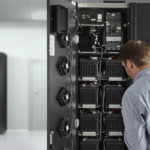
Data center technician working on nickel-zinc battery cabinet

For data centers, few things rival the importance of ensuring service reliability 24-7. Without this consistency, the day-to-day operations of countless critical sectors — from telecommunications to emergency medical services — can be severely disrupted, risking individuals’ safety and hampering economic growth.  

This underlines why data centers are cautious about protecting their assets, and why choosing the right uninterruptible power supply (UPS) system is particularly important. To ensure that these systems can support the data center’s needs at any time, they require the best battery technology to power them. 

Lead-acid batteries have a long history as the default choice, but the proliferation of new innovations and technologies has changed this in recent years. Now, data center operators have the option of choosing between a variety of battery chemistries, each of which comes with unique advantages.  

When analyzing what battery type is best for their data center workflow, managers should keep in mind these key components:  

Physical Footprint 

The physical size of a UPS system plays a significant role in the layout and internal organization of data centers. Out of the commercial battery varieties, lead-acid has the largest footprint: it possesses the lowest power density, and therefore requires significantly more space than lithium-ion or nickel zinc (NiZn) technology to accommodate the same amount of storage. While this doesn’t pose a challenge for every facility, it does mean that lead-acid batteries are poorly suited for modular facilities, as well as for data centers in expensive urban areas. In comparison, NiZn batteries use up to 65% less linear footprint and thus allow modular builders and construction teams to better optimize their buildouts.  

ZincFive BC 2 UPS Battery Cabinet with engineer reviewing the system

Improving Data Center Profits with Compact and Safe Backup Batteries

Read Blog

Total Cost

Cost inevitably plays a decisive role in selecting the right battery type. It’s important for data center managers to factor both capital expenditures and long-term operational costs into their investment decision. 

Lead-acid batteries have the distinct advantage of being the lowest upfront-cost option on the market. They do, however, require regular maintenance to preserve their average 5-year lifespan. Though an attractive option because of their low initial capital cost, lead-acid batteries are the most expensive to operate in the long run — an important consideration for data center managers.  

On the other hand, lithium-ion and NiZn batteries have a higher upfront cost but have a longer life and require less maintenance once installed. For example, by lowering operating expenses (OpEx), NiZn solutions reduce ownership costs by up to 28% over lead-acid based UPS products across the total UPS useful life. 

Sustainability

The environmental impact of data centers has gained increasing attention in recent years as businesses face growing pressures from investors, consumers, and regulatory agencies to integrate sustainability into their operations. A third-party expert analysis was conducted to assess the sustainability of various battery chemistries. The study compared factors such as GHG emissions, water footprint, energy use footprint, and volatile organic compounds. The study also provides GHG Protocol Scope 3 level emissions analysis. This information helps data center operators make sustainability one of the top factors in picking a technology – the best choice for both the environment and their company’s reputation. 

Closing the Emissions Gap: Data Center Sustainability

Read Blog

Reliability 

Unfortunately, the very UPS system meant to prevent an outage too often causes one; accounting for 37% of data center outages, on-site power failure is still the most common cause of significant data center outages. The majority of these on-site outages (53%) are caused by UPS failure and often cost over $100,000 to repair.  

One distinct reliability advantage is the ability to sustain battery discharge despite failure of an individual battery cell. In a UPS system, individual batteries are connected in a serial string (with multiple strings often paralleled) to support the required system voltage, power output, and run time. When a lead-acid or lithium-ion cell fails, it creates a high impedance or an open circuit that halts battery string operation. One single cell could be the difference between having the backup capacity needed or none at all, leaving the data center at unnecessary risk. Unlike lead-acid and lithium-ion, NiZn cells remain conductive when weak or depleted, allowing for continuous string operation and uninterrupted uptime.  

Safety 

The safety of data center workers and equipment is paramount when choosing batteries. Selecting a battery type that’s inherently non-flammable removes significant risks and makes the data center safer. For example, cell-level testing with the UL 9540A test method has revealed that NiZn batteries do not exhibit thermal runaway and are non-flammable, making them a safe choice for data centers and their workers alike.  

Whichever battery type they choose, data center operators can help ensure their batteries’ safety by having them adhere to the National Fire Protection Association (NFPA) 1 (National Fire Code),  the NFPA 855 standard, and the International Code Council’s (ICC) International Fire Code (IFC) 2021. These standards list both the installation safety rules for energy storage systems and testing procedures for batteries. 

Additional Resources 

As the number of options on the market grows, choosing the storage technology best suited for your data center has major impacts on cost, energy efficiency, sustainability, and safety. That’s why the Institute of Electrical and Electronics Engineers’ (IEEE’s) 1679 document family helps users, integrators, and servicing organizations compare traditional stationary battery technologies with newer, advanced technologies. These documents guide the user to select the best battery type for their needs. If you’re considering an energy storage purchase, the IEEE 1679-2020 document and its child documents (IEEE 1679.1, 1679.2, 1679.3 and 1679.4) are invaluable tools. 

Previously Published with Energy Storage Journal

  • batteries, 
  • footprint, 
  • nickel-zinc, 
  • reliability, 
  • safety, 
  • sustainability
Author
Tod Higinbotham, ZincFive CEO
Tod Higinbotham
CEO, ZincFive
Tod has a strong track record of successfully growing advanced materials companies in the energy storage, semiconductor, and solar markets. He served as Executive VP/GM for ATMI and led the rapid growth of the company, which sold more than $1 billion. Tod was an executive member of the leadership team at Advanced Silicon Materials, a world leader in high-purity silicon materials, the business that was sold to REC to form their solar materials business. He was formerly the CEO of PowerGenix, the company that pioneered the novel nickel-zinc battery technology that has become the core of ZincFive’s solution portfolio.

Closing the Emissions Gap: Data Center Sustainability

September 14, 2023
ZincFive BC 2 UPS Battery Cabinet powered by nickel-zinc batteries

Tim Hysell, Co-founder and CEO of ZincFive, shares how data centers can reduce their customer’s scope 3 emissions.


Although scope 3 emissions form the vast majority of many organizations’ carbon footprints, they’re also the most difficult to track. As a result, many organizations have been hesitant to disclose this category of emissions. However, investor pressure to disclose scope 3 emissions is growing, and as companies look to reduce their emissions, data centers are increasingly under the microscope as an opportunity for impactful reductions, considering they are one of the most energy-intensive components of their customer’s supply chains.

The data center industry, and its associated energy use, is in the midst of rapid growth. In the US market alone, data center demand — measured by power consumption to reflect the number of servers a data center can house — is expect to reach 35 gigawatts (GW) by 2030, up from 17 GW in 2022. According to the iMasons Climate Accord, data centers currently account for around 2.4% of today’s global energy consumption.

When data center services are contracted out to outside parties, these emissions are classified under the data center clients’ scope 3 emissions. Data centers looking to address scope 3 emissions can leverage vendors that employ environmentally friendly practices and thus offer a reduced carbon footprint compared to their competitors.

Inside of a modular data center

Making The Most of Your Modular Data Center Power System

Read Blog

Data centers can practice several methods to reduce their carbon footprint, such as modular construction, optimizing cool airflow, and alternative fuels for generators. Alternative battery chemistries for backup power systems can also help data centers improve their sustainability. For instance, nickel-zinc batteries save an average of 112kg of CO2 per kWh compared to lithium-ion batteries, and 36kg of CO2 relative to lead-acid batteries. They’re also manufactured more sustainably, with fewer emissions per kWh of stored energy. Over their lifecycle, nickel-zinc batteries provide four times the greenhouse gas avoidance of lead-acid batteries and six times that of lithium-ion, giving the technology a 9.4 out of a possible 10 Climate Impact Score according to Boundless Impact Research and Analytics.

As the appetite for scope 3 emissions disclosure increases, data centers should look to improve their value by adopting sustainable practices. Data center operations offer various opportunities for emission reductions, and those who want an edge in attracting and retaining customers should embrace and promote their sustainable practices, letting businesses know that they’re ready to support their data needs while also helping meet their ESG targets.

Previously published with Data Center Frontier

Tags:
  • batteries, 
  • data centers, 
  • nickel-zinc, 
  • power solutions, 
  • Scope 3 emissions, 
  • sustainability
Author
Tim Hysell, ZincFive CEO
Tim Hysell
Co-Founder & CEO, ZincFive
Tim has over three decades of entrepreneurial success in founding, owning, and directing profitable business operations in renewable energy, banking, manufacturing, and medical devices. His companies partnered with global giants such as Siemens, Phillips, and Hewlett-Packard. Prior to owning his own businesses, Tim worked for General Electric, Hewlett-Packard, and Providence Health Systems. Tim is also a co-founder and board member of Pacific West Bank in Oregon.

Improving Data Center Profits with Compact and Safe Backup Batteries

June 6, 2023
ZincFive BC 2 UPS Battery Cabinet is safe, powerful, reliable and sustainable

Data centers are facing aggressive growth in demand, which in the U.S. alone is expected to double by 2030, according to McKinsey. To meet this demand, operators are constructing new data centers and retrofitting existing ones to improve efficiency. However, it’s important for data center designs to use space more efficiently and minimize their physical footprint to keep costs down, especially in urban areas that traditionally have higher real estate prices and taxes.

Data centers need to support increasing customer demand for more data, faster service, AI, IoT, digital content, and hybrid cloud solutions, which requires more equipment, to increase capacity. But the larger the data center’s footprint, the more expensive it is to manage and maintain. To maximize profitability, it’s essential to do more with less space.

Maximizing physical space leads to more efficient operations. Data centers categorize space into “white space,” which includes equipment that increases capacity and generates profits, and “gray space,” which includes back-end support systems that do not directly generate profit. Minimizing gray space with smaller, power-dense equipment allows operators to maximize the profit-driving white space. Upgrading to more efficient infrastructure equipment can be costly initially but leads to significant reduction in total cost of ownership (TCO).

Upgrading to a UPS battery system with a smaller footprint is a great place to start. You can choose a UPS battery with a smaller footprint to minimize gray space and create more white space. It is advisable to look for a battery cabinet with the smallest linear footprint so that you can use more power in a smaller space. By selecting batteries with higher power density, you can reduce the number of required battery cabinets, which creates more room for additional servers or a smaller facility. 

The manufacturing of containerized/modular data centers

Why Modular Data Centers are Good for the Environment

Read Blog

For example, modular data centers can reduce the footprint and cost of containerized electrical rooms by using smaller, more power-dense equipment. Modular data centers offer flexibility, scalability, faster and more cost-effective construction, better quality, and greater customization. They can be deployed in almost any location and can be added to over time, allowing for real-time alignment with capital and operational resources. They are built and tested in the factory, providing more consistent quality and lower cost. They also allow for more customization, with owners able to mix and match components to meet their needs and adapt to cost, space, and other considerations. In addition, a modular design supports sustainable construction and operation of a data center since components are only added when needed.

In addition to small footprint, non-flammable battery chemistries like nickel-zinc eliminate the need for additional safety equipment, permitting, and space requirements of lithium-ion batteries, reducing the footprint of batteries even further. Nickel-zinc batteries are safe, and non-flammable – they don’t exhibit thermal runaway. They can reliably deliver more power faster, at high temperatures, and do it safely, year after year. Compared to lead-acid and lithium chemistries, nickel-zinc batteries’ greater safety lowers energy storage infrastructure as well as costs for battery shipping and installation. This safety advantage delivers savings in materials, lower shipping weight, no transportation restrictions, and ability to ship energy storage systems completely assembled.

For instance, ZincFive UPS battery cabinet offers the industry-leading footprint with the smallest cabinet and fewest cabinets per megawatt in the industry while providing the same amount of power as larger lithium and lead-acid battery solutions.  With an 84″ linear width, ZincFive UPS battery cabinets can deliver 1250kW of power, compared to lead-acid and lithium batteries, which require 65% and 45% more width respectively to provide the same amount of power.

ZincFive BC 2 UPS Battery Cabinet in data center

The BC 2: Innovative Cabinet Design Meets Unrivaled Battery Performance

Read Blog

This not only saves space in the data center for equipment that generates revenue but also makes shipping, installation, and maintenance more straightforward. Additional space can be used for revenue-generating equipment, such as installing more servers or other IT equipment, resulting in higher profits. 

Using smaller, more efficient equipment helps data centers save energy costs, reduce overall carbon footprints, and offer more affordable, sustainable services, which is a significant advantage in attracting and retaining customers in an increasingly competitive industry.

Previously Published by Data Center Frontier

Tags:
  • high power density, 
  • modular data center, 
  • nickel-zinc, 
  • small footprint
Author
Tod Higinbotham, ZincFive CEO
Tod Higinbotham
CEO, ZincFive
Tod has a strong track record of successfully growing advanced materials companies in the energy storage, semiconductor, and solar markets. He served as Executive VP/GM for ATMI and led the rapid growth of the company, which sold more than $1 billion. Tod was an executive member of the leadership team at Advanced Silicon Materials, a world leader in high-purity silicon materials, the business that was sold to REC to form their solar materials business. He was formerly the CEO of PowerGenix, the company that pioneered the novel nickel-zinc battery technology that has become the core of ZincFive’s solution portfolio.

Hydrogen vs BEVs: Refuelling Stations Shouldn’t Have to Choose

May 30, 2023
ZincFive Nickel-Zinc battery cabinet is the industry-first integrated distributed energy solution for EV charging, hydrogen fueling, and backup power for the grid and critical assets, including data centers.

Automotive industry experts have spent the last decade comparing the pros and cons of battery electric (BEVs) and hydrogen fuel cell electric vehicles (FCEVs), particularly medium- and heavy-duty trucks. Several insist that either one or the other is the transportation fuel of the future, leading to a heated debate.

But this is like pitting solar against wind in the fight to clean up power sources. When both have proven their place in a robust clean energy grid, isn’t the actual competition between zero-carbon fuels and polluting fossil fuels? Why should the industry choose between BEVs and FCEVs when it can have both?

Pros, cons, and best uses for FCEVs and BEVs

FCEVs and BEVs carry distinct features that suit different use cases. For example, FCEVs’ range is equivalent to similarly sized internal combustion engine vehicles, while BEVs’ range per charge varies according to the size of the onboard battery. FCEVs generally refuel faster than BEVs (three to five minutes vs 30 minutes to hours for BEVs). This often makes FCEVs the best choice for long-haul, heavy-duty use cases, especially for travel in areas where electric infrastructure is outdated or otherwise unable to meet increased charging demand.

Why should the industry choose between BEVs and FCEVs when it can have both?

Tod Higinbotham

However, faster refuelling doesn’t mean easier. Hydrogen fueling requires significant investment in production and fuelling facilities, including high-cost compressors and pressure tanks, as well as expensive transportation. This hinders the rapid expansion of infrastructure nationwide.

In contrast, BEV charging infrastructure leverages existing distributed electric grid infrastructure and has a more extensive, continually growing national infrastructure of charging stations. Many owners can charge their BEV at home or, in the case of fleet operators, install charging stations at their depot or warehouse.

Assuming the necessary infrastructure is in place (as in California), the long-range of hydrogen transport can be better suited for medium- and heavy-duty travel such as trucking. Electric vehicles’ more variable range, longer charge time, and layperson-friendly charging process make them ideal for lighter-duty travel such as personal vehicles.

Both have a place on the road

FCEVs and BEVs both use zero-emissions technologies that can play pivotal roles in the clean energy transition. Instead of pitting the two against each other, let’s find ways for them to complement each other in creating a cleaner road.

One solution is for manufacturers to develop a new kind of hybrid vehicle that can run on both energy sources: hydrogen fuel cells for longer distances, and an electric battery for shorter ones. For example, car manufacturer Renaut recently unveiled an electric-hydrogen hybrid concept car.

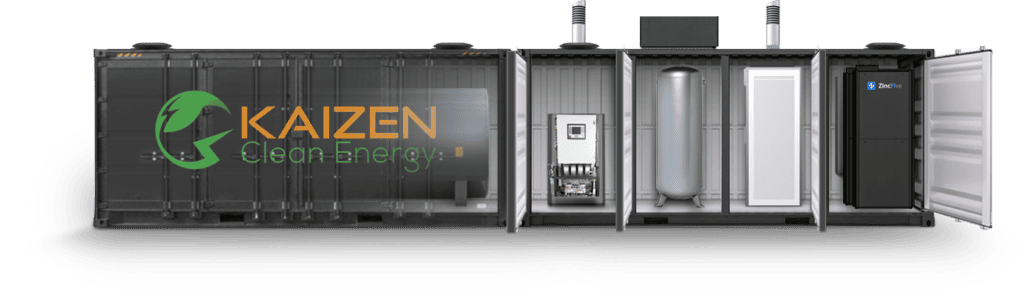
Another option is to utilise dual fuelling stations that provide the infrastructure to serve both hydrogen and electric trucks, such as the portable microgrid solution recently announced by Kaizen Clean Energy (KCE). Since it’s portable, widespread adoption doesn’t require excessive upfront infrastructure investment by station owners. It also eliminates the cost of hydrogen transportation by generating hydrogen on-site with commonly available methanol, which can be both used for hydrogen fuel and converted to electricity for EV charging. In this way, methanol lowers the overall cost of hydrogen and electric fuelling.

This microgrid solution can both connect to the grid to supplement available power, and be completely islanded for resiliency during grid outages. As an added safety measure, these stations utilise nickel-zinc batteries, which eliminate the risk of fires due to thermal runaway. The nickel-zinc chemistry also provides high power in a small footprint, allowing the system to fuel on-demand.

By pursuing both hydrogen and electric solutions aggressively and simultaneously, each in the area to which it’s best suited, we can accelerate the transportation sector’s decarbonisation. Let’s create and implement more solutions like these, which help to win the bigger battle against climate change by deploying the full portfolio of clean energy solutions and erasing the false dichotomy in fuel choice.

ZincFive to Accelerate the Deployment of EV Charging and Microgrid Solutions for DC Fast Charging, Utility and Industrial Applications

Read Press Release

Previously published in Automotive World

Tags:
  • EV charging, 
  • Mircogrid, 
  • nickel-zinc
Author
Tod Higinbotham, ZincFive CEO
Tod Higinbotham
CEO, ZincFive
Tod has a strong track record of successfully growing advanced materials companies in the energy storage, semiconductor, and solar markets. He served as Executive VP/GM for ATMI and led the rapid growth of the company, which sold more than $1 billion. Tod was an executive member of the leadership team at Advanced Silicon Materials, a world leader in high-purity silicon materials, the business that was sold to REC to form their solar materials business. He was formerly the CEO of PowerGenix, the company that pioneered the novel nickel-zinc battery technology that has become the core of ZincFive’s solution portfolio.

How Diverse Chemistries Strengthen the Battery Supply Chain  

April 27, 2023
ZincFive nickel-zinc monobloc batteries and cylindrical cells which are safe, powerful, reliable and sustainable

Battery energy storage helps ensure the reliability of mission-critical infrastructure such as data centers, transportation systems, and increasingly, the grid itself. So in a world of disrupted supply chains, it’s high time to safeguard battery supply chains by expanding the use of multiple battery types and chemistries. Applying the best-fit battery chemistry for each job simultaneously reduces risk and improves the performance of our battery energy storage infrastructure.  

The White House has publicly recognized batteries’ crucial role in our grid and communication systems. Last March saw the president invoke the Defense Production Act to spur domestic mining and processing of minerals used to make batteries for electric vehicles and energy storage facilities. In May 2022, the Department of Energy announced that $3.16B from the $65B Infrastructure Investment and Jobs Act would go towards (among other activities) supporting domestic critical mineral supply chains used in battery production. The Inflation Reduction Act, enacted last summer, provides battery cell manufacturers with tax credits for batteries produced domestically. The Administration’s praiseworthy efforts will help lower costs and improve our competitive position for lithium materials and battery chemistries. However, we must do more to secure our battery supply chains.  

To ensure widely available energy storage solutions, we need to diversify the use of battery chemistries and materials. A variety of battery chemistries have recently emerged that use more readily available materials, looking beyond lithium. Adding other battery types to our energy storage mix relieves stress on the overall battery material supply chain, preserving those limited resources for applications that require their exact performance qualities.   

For example, lithium-ion batteries are a good fit for electric vehicles because they have high energy density relative to their weight. They can store vast amounts of energy in a lightweight package, then release that energy slowly over the course of several hours (even days) of use. This allows them to power cars for long periods of time without overburdening the vehicle and makes them ideal for mobile phone applications, where lightness and long-term battery power also matter.  

ln contrast, some energy storage applications require the opposite: high-power density batteries that can deliver massive amounts of electricity for a short time period. For instance, data center backup power systems require batteries that can power the entire data center and prevent catastrophic data losses in case of a power shortage – but only for a few minutes, until the backup generators kick in. Such applications benefit from power-dense batteries such as nickel-zinc, which are designed to safely handle critical short-duration needs for high electricity loads.  

There are other battery types that offer attributes best suited for certain applications. Flow batteries are able to grow energy storage capacity without affecting the power rating. Flow technology stores energy in tanks of liquid electrolytes, separating the energy storage section of these batteries from the power production section. So increasing a flow battery’s energy storage only requires increasing the tank size, not buying a new battery. This easily increased energy storage capacity makes them a promising option for grid-scale, long-duration energy storage. And like nickel-zinc, these batteries provide greater safety than lithium because of their inherent non-flammability.  

ZincFive nickel-zinc monobloc batteries inside our BC Series UPS Battery Cabinet

The Powerful Benefits of Nickel-Zinc Batteries for Data Centers

Learn More

Other battery chemistries in development include zinc-manganese dioxide,ion, and rechargeable aluminum – each with their own set of benefits (safety, availability of materials, affordability, and longevity) and suitable applications.  

Nickel, zinc, aluminum, iron, and other alternative base materials are often much more available and less expensive than lithium, and can require a less intensive mining process. Using more widely available, less expensive materials for stationary applications strengthens the battery supply chain and associated production capacity.  

This is particularly crucial in light of lithium’s increasing demand as the electric car and grid storage markets grow. Lithium demand is projected to triple from 2020 levels by 2025, risking global shortages. For battery-dependent operations to continue functioning smoothly, lithium batteries should only be used where they’re truly needed – for example, electric cars.  

Since other battery chemistries like nickel-zinc are better suited for backup power and short duration ancillary services, using them in those cases will relieve the growing demand for lithium. By focusing specific chemistries for the applications they’re best suited for, we can use a wider range of batteries overall and thus ease price increases and supply shortages. 

No single battery chemistry can be the perfect fit for all of the continually expanding battery applications – vehicles, transportation systems, grids, data centers, and more. A greater selection of chemistries lets operators prioritize specific advantages such as greater sustainability, space conservation, maintenance costs, reliability, and safety. Microgrid developers and users have already realized this – they’re increasingly turning to more diverse battery chemistries, and even using multiple types of batteries to fulfill different functions in the same microgrid. 

Supporting a wide number of chemistries allows optimization for different applications, eases pressure on supply chains, and helps reduce costs throughout the industry. If we want to strengthen the battery supply chain – ever more urgent as the demand for energy storage continues to rise – we must support the development and adoption of alternative chemistries.  

Previously published by Renewable Energy World

Author
Tim Hysell, ZincFive CEO
Tim Hysell
Co-Founder & CEO, ZincFive
Tim has over three decades of entrepreneurial success in founding, owning, and directing profitable business operations in renewable energy, banking, manufacturing, and medical devices. His companies partnered with global giants such as Siemens, Phillips, and Hewlett-Packard. Prior to owning his own businesses, Tim worked for General Electric, Hewlett-Packard, and Providence Health Systems. Tim is also a co-founder and board member of Pacific West Bank in Oregon.
  • batteries, 
  • supply chain

The Sustainability Advantages of Nickel-Zinc Batteries

April 4, 2023
Nickel-zinc monobloc battery has sustainability benefits

Nickel-zinc (NiZn) batteries are a more sustainably sourced and environmentally friendly alternative to other battery chemistries. 

Climate Impact Profile by Boundless Impact Research and Analytics compared the environmental impact of lead-acid, lithium and NiZn batteries, demonstrating that NiZn has advantages with lower GHG emissions, water footprint, energy footprint, carbon payback time, material use, and volatile organic compounds (VOCs). 

Combining these metrics, NiZn had a 9.4 out of 10 impact score on its overall performance, with higher scores representing higher positive environmental impact. The cradle to grave carbon footprint of a nickel zinc battery is significantly less than lead-acid or lithium batteries.

nickel-zinc batteries have the highest positive climate impact score

Here’s a more detailed breakdown of each element on the chart:

  • Material Use
    NiZn batteries use common, highly available, conflict-free materials which are also highly recyclable. Nickel and zinc are respectively four and five times more abundant in the earth’s crust than lithium and lead. In addition, while lead exposure is a global health concern and lithium’s reactivity to air and water makes it a fire hazard, nickel and zinc are non-toxic and non-flammable.
  • Greenhouse Gas Emissions
    Nickel-zinc batteries’ lifetime greenhouse gas emissions are four times lower than lead-acid and six times lower than lithium-ion emissions. Since nickel and zinc sourcing require fewer emissions and NiZn battery manufacturing carbon footprint is lower, users purchasing $1M of NiZn batteries save 148,255 tons of CO2e – a 537 percent improvement over lithium, and a 1,700 percent improvement over lead-acid batteries.
  • Carbon Payback Time
    Carbon Payback Time (CPT) measures the time it takes for a battery to offset its cradle to gate carbon footprint. NiZn chemistry’s CPT is between 0.16 and 0.21 years – 400% faster than lithium-ion and lead-acid batteries.
  • Volatile Organic Compounds (VOCs)
    Emitted as gases from solids – including those used to produce lithium-ion and lead-acid batteries – VOCs are infamous for causing short-and long-term adverse health effects. A healthier alternative, NiZn batteries do not use VOCs in production.
  • Water Footprint
    Even including water requirements for raw material extraction, a NiZn battery still demands 96% less water from cradle to gate than the average lithium-ion battery.
  • Energy Footprint
    The energy footprint, manufacturing to gate, for NiZn is 23-33% less than that of lithium-ion batteries and lead-acid pure-lead batteries.

ZincFive’s commitment to sustainability and the environment extends beyond its products. 

ZincFive is a member of the Initiative for Responsible Mining Assurance (IRMA), as part of the company’s continued commitment to safeguard human rights, communities impacted by mining, and the broader environment.as part of the company’s continued commitment to safeguard human rights, communities impacted by mining, and the broader environment. IRMA works to advance responsible mining practices, providing third-party verification and certification against comprehensive environmental and social criteria for all mined materials. Membership in the initiative is the latest development in ZincFive’s commitment to promote ESG standards within the company for the benefit of all stakeholders.

ZincFive webinare on nickel-zinc climate impact report

Climate Impact Profile

Boundless analyzed the climate impact of the ZincFive nickel-zinc (NiZn) battery technology, taking into account key performance indicators such as greenhouse gas (GHG) emissions, water footprint, energy footprint, and hazardous material requirements, scoring ZincFive’s NiZn batteries at 9.4 with 10 representing the highest positive environmental impact.
Read Paper
Tags:
  • batteries, 
  • nickel-zinc, 
  • sustainability

Three Ways to Improve Data Center Sustainability

March 21, 2023
Two data center operators reviewing and overseeing data center operations

In today’s information and technology-driven economy, data centers are fundamental to maintaining the day-to-day operations that keep businesses, organizations, and governments running. They act as centralized information hubs and enable the storing, processing, and dissemination of data and applications — vital to the operational continuity underpinning contemporary economic growth.  

The intense processing power behind data centers inevitably means that they demand significant energy resources and produce heat waste. In fact, data centers are so energy intensive that they account for 2.4% of global electricity usage and 0.5% of greenhouse gas emissions (GHG) in the United States, which contains more data centers than any other country. 

The outsized environmental impact of data centers has garnered increasing attention in recent years as businesses face growing pressures from investors, consumers, and regulatory agencies to integrate sustainability into their operations, and the industry is responding. For many organizations, data centers comprise a significant portion of their overall emissions (either scope 1 or 3, depending on ownership), making the issue quite salient. 

The good news is the variety of ways in which data centers can upgrade their facilities to meet evolving pressures, hedge against uncertainty, and become more sustainable, efficient, and highly cost-effective. Effective methods include optimizing airflow dynamics, adopting modular design, and switching to alternative battery technologies like nickel-zinc.  

Optimizing Cool Airflow

The industry-recognized optimization standard for data center infrastructure (“hot aisle/cold aisle”) was pioneered in 1992 by IBM’s Robert Sullivan — an internationally recognized engineer — and remains a practical way of boosting existing cooling technology without needing additional capital investment. In this specific configuration, cabinets containing processors are placed so that the front of one will never face the back of another, where heat exhaust escapes.  

Rearranging a data center in this manner effectively creates alternating rows of cold supply and hot return air, reducing energy usage. It’s also important to reinforce the separation of alternating aisles with physical barriers that seal off gaps for air and to clear airflow obstructions — often poorly placed cables — from intake and exhaust openings. Doing so will deliver the highest-quality airflow dynamics, guaranteeing reduced energy costs, improved corporate sustainability metrics, and greater operational reliability.  

ZincFive nickel-zinc monobloc batteries inside our BC Series UPS Battery Cabinet

Batteries and Cooling Combine for Data Center Sustainability

Read Blog

Another economic — albeit geographically and logistically restrictive — way data centers can optimize their airflow is by making use of free air cooling. As the name suggests, free air cooling is a process whereby external ambient air temperatures are used to cool data centers’ processors via heat exchange. The caveat of this cooling method is that it’s location-dependent — and many of the most attractive places for data centers to locate (i.e. big tech hubs) don’t have the required climatic conditions.  

Mountainous and some northern hemisphere regions are especially effective for free air cooling, as they boast low and stable temperatures year-round.  

Modular Data Centers

The manufacturing of containerized/modular data centers

A recent survey of data center executives revealed that over half have already deployed modular data centers, and 99% plan to in the future. Made from prefabricated units and preconfigured equipment, prefabricated modular data center systems (PMDCs) can be deployed in a much wider array of locations than traditional facilities, and offer multiple benefits: reduced costs, faster construction, greater customization, and easier scaling of the data center’s equipment and systems over time.

PMDCs’ ability to add and replace components as needed provides several environmental benefits. Since they don’t need to be designed on a massive scale on location, they generally have smaller footprints, more efficient power and cooling options, and the ability to easily replace equipment with more climate-friendly alternatives such as nickel-zinc batteries. Some modular data centers can even be built in existing buildings, lowering the construction footprint even further. As the survey shows, data center operators plan to take full advantage of modular designs’ financial and environmental benefits in 2023 and beyond. 

Sustainable Backup Batteries

Batteries comprise an integral part of information technology but are often overlooked when it comes to a data center’s sustainability directives. Since even a few seconds of data center downtime can disrupt operations around the world, uninterruptible power supply (UPS) systems are essential to maintain uptime during a power outage. These UPS systems must contain backup batteries, which present a key opportunity for contributing to sustainability goals. 

For example, because nickel and zinc are four and five times more abundant in the Earth’s crust than lead and lithium, and boast more sustainable mining processes, nickel-zinc batteries have six-times the GHG avoidance compared to lithium-ion, and four-times relative to lead-acid. They also reduce overall water usage, eliminate volatile organic compounds during manufacturing, and are non-flammable. 

Additionally, nickel-zinc allows for higher operating temperatures, offering reduced cooling requirements and resulting in energy savings. In many cases, the UPS is rated to operate at up to 104°F (40°C) or higher, but the battery operating temperature limits the ability to increase temperature and reduce cooling costs in that space. Fortunately, nickel-zinc can tolerate higher temperatures, thus providing an opportunity to reduce cooling costs and improve Power Usage Effectiveness (PUE) and sustainability. 

BC UPS Battery Cabinet with door open showcasing nickel-zinc batteries which are safe, powerful, reliable and sustainable

The Powerful Benefits of Nickel-Zinc Batteries for Data Centers

Read Blog

Unsurprisingly then, nickel-zinc batteries have achieved the highest climate rating of 9.4/10 according to Boundless Impact Research and Analytics’ analysis of environmental and performance-based factors for battery chemistries commonly used in data centers. This is one of a few key reasons why Corscale recently announced that it will make use of nickel-zinc chemistry in its uninterruptible power supply system. 

Conclusion 

As major consumers of energy around the world, data centers have proactively taken it upon themselves to become leaders in reducing emissions, and are well-positioned to continue meeting the increasingly stringent environmental demands of investors, consumers, and regulatory agencies in the years to come. Though it’s not a silver bullet solution, the positive economics of airflow optimization, modular design, and alternative battery chemistries offer impactful, accessible, and low-risk ways of improving data center sustainability. 

Previously published by Data Centre Solutions

Author
Tim Hysell, ZincFive CEO
Tim Hysell
Co-Founder & CEO, ZincFive
Tim has over three decades of entrepreneurial success in founding, owning, and directing profitable business operations in renewable energy, banking, manufacturing, and medical devices. His companies partnered with global giants such as Siemens, Phillips, and Hewlett-Packard. Prior to owning his own businesses, Tim worked for General Electric, Hewlett-Packard, and Providence Health Systems. Tim is also a co-founder and board member of Pacific West Bank in Oregon.
Tags:
  • cooling, 
  • data centers, 
  • modular, 
  • sustainability

4 ways nickel-zinc batteries can save data centers money

December 1, 2022
A row of ZincFive BC UPS Battery Cabinets

Data center operators face continual pressure to deliver more with less: to improve data centers’ reliability, safety, and sustainability, all while working under economic constraints.

In this attempt, many have overlooked the uninterruptible power supply (UPS) system – but now that thoroughly tested nickel-zinc (NiZn) batteries have proven themselves on the market, they offer an opportunity to deliver all three benefits in one cost-effective package.

These batteries improve data centers’ reliability, sustainability, and safety, all while simultaneously delivering cost savings. Here’s how:

1. Smaller battery footprint = Reduced infrastructure costs

Space is at a premium in data centers, as precious square footage is prioritized for profit-making equipment such as data storage and servers. For infrastructure such as UPS systems, the less space they take up, the better.

This is where nickel-zinc batteries shine. They’re the highest power density batteries available for data centers, with about twice the power density of lead-acid batteries (the most common form of backup battery). This gives them the ability to support a large power demand for a short period of time, with a small footprint.

During a typical data center outage, the generator comes online in under a minute and supports the data center for the length of the outage, so the UPS battery is only required to transition the data center from utility to generator-supported operation.

A NiZn battery system nearly halves the space needed for batteries compared to traditional lead-acid and newer lithium ion solutions.

Nickel-zinc batteries’ smaller size and weight delivers multiple financial benefits because they not only open up more floor space for revenue-generating equipment, but also lower the capital cost of building data centers by reducing the space needed for battery storage.

2. Greater reliability = Fewer maintenance costs

Nickel-zinc batteries’ financial advantages go beyond a smaller space footprint: their greater reliability can save data centers hundreds of thousands of dollars.

This is because UPS failures are tied to expensive outages. Research from The Uptime Institute has found that outages are becoming longer and more costly, with one in five organizations reportedly experiencing a significant outage in the past three years.

However, 43 percent of outages in a data center are caused by the failure of the UPS system itself. Lead-acid batteries are often the culprits: they fail open or with a high impedance path, which prevents the battery from supporting the critical UPS load.

Nickel-zinc batteries’ greater reliability makes them ideal replacements for lead-acid batteries. First, they’re better suited to endure stress, especially varying temperatures. Second, their alkaline chemistry means that unlike lead-acid batteries, they do not sulfate over time. This extends their operating life to fifteen years – three times as long as lead-acid batteries’ lifespan.

Third, nickel-zinc batteries improve battery string reliability. When a cell in lead-acid or lithium batteries fails, it creates an open circuit that halts string operation. This results in two unwelcome scenarios: power backup failure for the entire battery string, and the operator having to pay for an expensive emergency maintenance event.

In contrast, a weak or depleted cell in a nickel-zinc battery remains conductive, which means the battery continues to discharge and carry the load. This means all that’s needed in the case of a weak or depleted NiZn cell is a simple battery replacement at the next planned maintenance cycle: little cost, and no operational impact.

Due to their greater resilience against environmental stressors, extended lifespan, and battery string reliability, nickel-zinc batteries help data centers protect themselves against the high costs of power backup failures.

3. Safer battery chemistry = Lower infrastructure, shipping and installation costs

Compared to lead-acid and lithium chemistries, nickel-zinc batteries’ greater safety lowers energy storage infrastructure as well as costs for battery shipping and installation. This safety stems from their non-toxic materials, lower shipping weight, lack of thermal runaway, no transportation restrictions, and ability to ship in energy storage systems completely assembled.

These characteristics make them easily shippable, with no special safety provisions needed – unlike shipping for lithium batteries, which have the potential for thermal runaway and require additional precautions and related expenses.

Once shipped, nickel-zinc batteries are also easily installed in both traditional and modular data centers. Due to their inflammable nature, they need no protective equipment, which reduces safety-related construction costs compared to the other battery types. Some battery cabinets also allow NiZn batteries to act as a drop-in replacement for lead-acid batteries, which lowers the barriers to replacing lead-acid with NiZn batteries.

4. Attract more customers with greater sustainability

Boundless Impact Research and Analytics carried out a Climate Impact Profile comparing the environmental impact of different backup battery chemistries, providing excellent information for data centers and their customers as they report Scope 3 emissions.

This profile revealed nickel-zinc batteries’ significantly lower impact on the environment across all six metrics of a battery life cycle analysis: carbon return on purchase (CROP), greenhouse gas (GHG) emissions, carbon payback time (CPT), volatile organic compounds (VOCs), water footprint, and energy footprint.

Put together, these environmentally friendly characteristics give nickel-zinc batteries the highest score for sustainability: 9.4 out of a possible 10.

Data center users are under pressure – and are increasing pressure on their data center operators – to report and reduce their impact on the environment. By offering an avenue to contribute towards sustainability goals, data centers can attract more customers and investors through their advantages in terms of environmental impact.

The (financial) power of good chemistry

Nickel-zinc UPS battery chemistries outperform lead-acid and lithium-ion solutions in performance, space footprint, reliability, safety, sustainability, and – as a result of these – cost effectiveness.

Their characteristics free up data center space and budgets for developing new capacity and services. These advantages change UPS and battery backup from a mere necessary overhead, into an opportunity to improve financial performance.

This post originally appeared in Data Center Dynamics

Tags:
  • batteries, 
  • data centers, 
  • nickel-zinc, 
  • reliability, 
  • safety, 
  • sustainability