

Artificial intelligence is challenging rack power density and battery backup

May 12, 2021
Stock image

Artificial Intelligence (AI) takes an awful lot of processing power. That’s putting real pressure on data center rack power density and rack-based battery backup.

The application of Artificial Intelligence (AI), Machine Learning (ML), and Deep Learning (DL) is business as the new usual. The rapid adoption of these applications has created an explosion in data center workloads. OpenAI—an artificial intelligence research laboratory—has released an analysis showing that since 2012, the amount of compute used in the largest AI training runs has grown by more than 300,000 times[1].

In other words, the computer resources consumed by AI has doubled every 100 days.

The AI age is skyrocketing on rack-based servers built around multiple CPUs/GPUs (with hundreds of cores integrated with terabytes of memory, multiple high-speed communication channels, DDR5 RAM memory, 100G+ Ethernet and other advances that all need increasing power.

What does this have to do with battery backup?

Powerful Racks Rely on Integrated Battery Backup

The massively increasing compute workload is gravitating to companies focused on vast cloud businesses. There are already over 500 hyperscale data centers operated by these firms. They, in turn, are opting for power infrastructures with battery backup distributed out to individual racks, in architectures such as those defined by the Open Compute Project (OCP).

Racks need more backup power, and the backup power is moving into the racks.

As a result, power density is becoming the topmost criteria for battery backup. While lead-acid battery technology has been the workhorse for decades, newer technologies can deliver more power density in the rack. Nickel-zinc (NiZn) technology, in particular, has specific advantages over lead-acid solutions – and lithium-ion chemistry as well – in terms of performance, safety, reliability, cost, and sustainability.

ZincFive NiZn battery backup solutions offer dramatically higher power density than lead-acid batteries when measured by either weight (Watt hours per kilogram) or by volume (Watt hours per liter). NiZn batteries have two times the power density and half the weight of lead-acid batteries. So a NiZn battery is about half as big of a comparable lead-acid battery—saving room in the rack for AI-churning servers.

More Power and Higher Safety With NiZn

While power density is critical, safety is the other side of the coin. Placing battery backup in the rack, instead of in a separate UPS facility, heightens the need for entirely safe operation to protect employees and equipment.

Data center operators concerned about the possibility of thermal runaway in lithium-ion batteries should note that NiZn batteries have been rigorously tested to the UL 9540A test method at cell level, and they did not exhibit thermal runaway in any of the five arduous and destructive test types in that test method. Comparable lithium-ion battery systems require a Battery Management System (BMS) to manage safe battery operation during UL 9540A testing.

Cell-level safety is a clear advantage when you put a battery next to expensive rack servers.

There’s more to the story, in terms of reliability, maintenance and sustainability. Get all the details in our new article, High Performance Computing Density Drives High Demands on Rack-level Battery Backup.

The high-density batteries for high density compute

As rack-level compute density drives power density levels continuously upward, backup battery requirements rise accordingly. The high-power density of NiZn batteries makes them the ideal choice, along with with smaller size and weight to allow easier integration into server racks. They also can reduce operating expenses by virtue of their superior safety, high reliability, wider operating temperature range, long life and simpler maintenance requirements. By simplifying the challenge of high density battery backup, NiZn batteries are the better choice for the hyperscale data center operators dealing with the boom in AI.

Read more about how to meet the high performance computing power density challenge.


[1] Programmer Info – ‘An Exponential Law For AI Compute’

Author
Steve Jennings, ZincFive SR VP Sales & Marketing
Steve Jennings
Sr. VP Sales & Marketing, ZincFive
Steve leads the ZincFive sales and marketing team and brings senior executive experience in technology companies serving the energy, clean tech, communications, computing and semiconductor industries. Steve and his team are focused on providing superior performing, safer and greener energy storage solutions based on nickel-zinc batteries to mission critical applications in the data center, IT and intelligent transportation markets.
Tags:
  • AI, 
  • batteries, 
  • high power density, 
  • nickel-zinc, 
  • sustainable, 
  • uninterruptible power supply

Ensuring ESS Safety in Data Centers with NFPA 855 – Part 2

April 7, 2021
ZincFive paper on how the NFPA 855 standards helps ensure ESS safety

Data center safety is a growing challenge as facilities expand in size and number, along with their UPS and battery systems. Now there is a single guiding document, NFPA 855, to help operators manage the potential risk from all that stored energy.

In the first blog post in this two-part series, we provided an overview of regulatory standards and codes from the National Fire Protection Association (NFPA) and the International Codes Council (ICC). We introduced the Underwriters Laboratories (UL) testing method and the best practices from the Institute of Electrical and Electronics Engineers (IEEE). Finally, we met NFPA 855, the fully coherent regulatory framework designed to organize the alphabet soup described above.

In this post, let’s learn more about how to evaluate ESS safety using NFPA 855.

Specific details of NFPA 855

Before the construction of a data center can begin, the operator’s representative will have to submit the chosen ESS supplier’s documentation, along with several other required documents including a Hazard Mitigation Analysis and the test report from an approved large-scale fire test to the AHJ. The information package must provide the AHJ detailed plans of the ESS installation, including the proposed floor layout and the operational parameters of the batteries specified, as well as details about smoke detection systems, thermal management, ventilation and fire suppression systems.

Below these thresholds, ESS systems using the various battery chemistries do not have to meet NFPA 855 requirements. For nickel-zinc (NiZn) and lead-acid this has been set at 70kWh of stored energy, though it should also be mentioned that no one NiZn or lead-acid battery string within an ESS deployment may exceed a 50kWh capacity. In contrast, the thresholds for Lithium-ion, Na-NiCl2 and flow batteries have been placed at just 20kWh.

Under NFPA 855, the maximum energy capacity inside a single battery room within the data center complex may, in some cases, be restricted. Lithium-ion and flow batteries will be restricted to 600kWh in total per fire enclosure area (i. e., battery room), while lead-acid and nickel-based batteries are not limited in capacity in a single fire enclosure area. Lead-acid batteries associated with a UL 1778 listed and labeled UPS system have the least restrictions placed on them, while other, more volatile battery chemistries have spacing limitations (three feet between cabinets and walls, etc.) and enhanced fire protection and explosion control/deflagration requirement that must be met.

These additional requirements, along with the required infrastructure upgrades required, may significantly increase the footprint and the up-front cost of these ESS offers.

Testing brings extra costs 

Other than lead-acid systems, any ESS with an energy storage capacity above the figures outlined in Table 1 will need to be tested in accordance with the UL9540A testing procedure at a certified lab. Carrying out such testing will determine if there is a propensity for thermal runaway to propagate within the battery, whether a fire will spread throughout the whole ESS, and how effective the fire protection measures are at preventing this from happening. It will also determine if flammable gases are given off that could exacerbate the situation. Depending on the report data derived from these tests, it is possible that reductions in spacing between cabinets or increases in storage capacity may be justified.

Since costs associated with UL 9540A testing could easily fall in the range of $50,000 to $100,000 or more, it can have a substantial impact on the total cost of ownership (TCO) of the ESS. There are other impacts as well in terms of the time and inconvenience of the testing process. 

UL 9540A testing costs can easily fall in the range of $50,000 to $100,000 or more.

Thanks to their safer characteristics, ESS installations that are based on either lead-acid or NiZn battery chemistries require less fire suppression apparatus (such as lower sprinkler density) than the lithium-ion equivalents. They also will not require explosion control venting needed for lithium-ion systems. All this adds to the list of TCO disadvantages when utilizing lithium-ion.

Better risk management now and in the future

Data center operators should now refer to NFPA 855 when designing, testing and installing ESS facilities to manage the risks of higher density battery systems. In addition, these new ESS standards are going to dramatically impact how future data center UPS back-up systems are managed and monitored once in operation.

NFPA 855 will also guide some aspects of upgrading and subsequent decommissioning of an ESS as well. If, in the future, a decision is made to apply the UL 9540A standard to existing ESS infrastructure, data center operators may have to retrofit compliant battery hardware too. This is certainly feasible at any installation where the AHJ feels a serious concern.

The arrival of the NFPA 855 means that data center operators and the ESS provider partners have the tools to give due consideration to safety across the full lifecycle of a planned UPS system. They can now understand operational parameters as well as the economic aspects that will have a substantial influence on deciding which battery chemistry should be employed in new installations.

Contact ZincFive if you have additional questions about NFPA 855, ESS safety and the TCO advantages of NiZn UPS batteries.

Author
Dan Lambert, ZincFive Codes & Standards Specialist
Dan Lambert
Senior Product Manager, ZincFive
Dan has over 40 years of commercial and industrial electrical experience and has worked with AC and DC power systems, with a primary focus on mission-critical power systems. Working with stationary battery systems since 1985, Dan has worked with many battery chemistries and has contributed to large scale energy storage analysis projects, as well as testing other storage systems. Dan is currently a member of the IEEE Power and Energy Society serving as the chairperson for the IEEE Energy Storage and Stationary Battery Committee’s IEEE 1679.4 Alkaline Chemistries Working Group and is a member of the Battcon conference Technical Committee.
Tags:
  • batteries, 
  • high power density, 
  • NFPA 855, 
  • safety, 
  • uninterruptible power supply

Ensuring ESS Safety in Data Centers with NFPA 855 – Part 1

March 31, 2021
ZincFive paper on how the NFPA 855 standards helps ensure ESS safety

As data centers expand in size and number, so will the demand for sufficient, reliable and safe backup power. UPS battery systems will get larger and distributed more widely, which will heighten scrutiny on potential hazards from all that stored energy.

In this first post in a two-part series, we’ll provide an overview of the latest regulatory requirements needed to meet regional fire codes and maximize safety, including the latest guiding document on the topic, NFPA 855.

More data centers + more power density = more potential risk

Gartner projects that the total annual spend on data center infrastructure will surpass $200 billion in 2021, representing a 6% rise over 2020. Uninterruptible power supply (UPS) systems play an increasingly critical role within the expanding data center architecture, maintaining operations should a power outage occur anywhere in the network.

In addition, increasing demands for Energy Storage System (ESS) power density have driven migration towards more dense battery chemistries, especially lithium-ion. The combination of higher power requirements and new technology can raise the risk of situations where thermal runaway and fire becomes a threat to staff and first responders, as well as to the services that depend on the data center’s servers and storage.

Data center operators, managers and engineers need to be familiar with the alphabet soup of regulatory requirements that help to operate their facilities safely. Fortunately, they now have one relatively new standard, NFPA 855, as the guiding document.

Meet the fire safety organizations

Both the National Fire Protection Association (NFPA) and the International Codes Council (ICC) periodically update their regulatory standards/codes relating to fire safety. Every authority having jurisdiction (AHJ) across North America will reference these, relying on either the NFPA 1 National Fire Code or the ICC’s International Fire Code.

To support the standards/codes published by these organizations, Underwriters Laboratories (UL) have defined stringent testing standards through which system safety can be verified. Among the ones that data center operators need to be most aware of are these:

  •  UL 1778, which directly relates to UPS;
  •  UL 1989 which pertains to standby batteries;
  •  UL 2054 which pertains to household and commercial batteries;
  •  UL 1643 which addresses lithium-ion technology in particular;
  •  UL 1973 which considers the electronic safety system accompanying the ESS;
  •  UL 9540, which covers both grid-connected as well as standalone systems; and
  •  UL 9540A test methodology by which thermal runaway is assessed.

To add yet another layer of complexity, recommended best practices produced by the Institute of Electrical and Electronics Engineers (IEEE) serve to inform the UL standards. These cover the various different battery chemistries that could be used in ESS deployments: IEEE 1187/8/9 for valve-regulated lead-acid, IEEE 1679.1 for lithium-ion selection, IEEE 1679.4 for aqueous alkaline chemistries, and IEEE 1105/15 for nickel-cadmium batteries. Though these are guidelines, and consequently do not have the legislative weight of the documents published by the NFPA or ICC, they are very important from an insurance perspective.

With dramatic increases in ESS deployment activity in the coming years—for renewable energy storage as well as for data center back-up—the industry has needed greater clarity on how to assess ESS safety. Those implementing an ESS have needed a fully coherent regulatory framework to organize the alphabet soup described above and simplify the way forward.

NFPA 855 is shaping up to be that framework.

NFPA 855 unifies ESS testing criteria

After several years in development, the NFPA published the NFPA 855 standard at the start of 2020. The principal objective of NFPA 855 is to bring together all the numerous criteria involved in ESS fire safety under one unifying standard.

The NFPA 855 standard sets out the installation safety rules to which an ESS must adhere. To ensure the ongoing safety of their ESS installations, data center operators should have a strong understanding of this new standard, covering all of the key aspects. UL 1778, UL 1973, UL 9540 and UL 9540A testing procedures are all cited within the document. IFC -2021 and the latest revision of the NFPA 1 National Fire Code, which are both due to be published later this year, will reference or parallel the requirements of NFPA 855.

IFC -2021 and the upcoming revision of the NFPA 1 National Fire Code will reference or parallel the requirements of NFPA 855.

In the second post in this two-part series , we’ll explain more about what NFPA 855 is and how to use it.

Author
Dan Lambert, ZincFive Codes & Standards Specialist
Dan Lambert
Senior Product Manager, ZincFive
Dan has over 40 years of commercial and industrial electrical experience and has worked with AC and DC power systems, with a primary focus on mission-critical power systems. Working with stationary battery systems since 1985, Dan has worked with many battery chemistries and has contributed to large scale energy storage analysis projects, as well as testing other storage systems. Dan is currently a member of the IEEE Power and Energy Society serving as the chairperson for the IEEE Energy Storage and Stationary Battery Committee’s IEEE 1679.4 Alkaline Chemistries Working Group and is a member of the Battcon conference Technical Committee.
Tags:
  • batteries, 
  • data centers, 
  • high power density, 
  • NFPA 855, 
  • safety, 
  • uninterruptible power supply

Comparing the Climate Impact of Batteries on Data Center Sustainability

March 9, 2021
ZincFive paper on nickel-zincs climate impact

To make deeper cuts in greenhouse gas (GHG) emissions, data center operators need to take a look at the bigger picture.

In a prior blog post, we pointed out how lead-acid batteries are a data center sustainability challenge hiding in plain sight. Lead-acid batteries contain significant amounts of lead and other hazardous materials that create a highly pollutive and hazardous recycling process. In fact, environmental organizations have identified used lead-acid battery recycling as the world’s #1 pollution problem.[1]

Lithium-ion batteries are not much better. For example, the extraction of lithium has significant environmental and social impacts, from water pollution and depletion to leaching, spills and air emissions of toxic chemicals.[2] And that’s simply for manufacturing: lithium-ion batteries do not yet have a clear, self-funded path to recyclability at end-of-life.

It’s for reasons like these that a recent Climate Impact Report gave NiZn batteries the best climate impact score for any backup battery technology—9.4 out of 10.  Let’s look deeper at the paper’s analysis to understand the bigger picture of how backup batteries impact data center sustainability.

Superior GHG emissions savings

The most direct way to evaluate environmental impact is by comparing a battery’s Carbon Return on Purchase (CROP) with that of other chemistries. CROP measures the greenhouse gases (GHG) avoided per kWh of customer energy storage.

In the report from Boundless Impact Research & Analytics[1] which was reviewed by an independent battery industry expert, analysis showed that ZincFive’s NiZn batteries offers six times or more avoidance of GHG emissions compared to lithium-ion and four times more compared to lead-acid chemistries.

The Climate Impact Profile also compared the battery chemistries for Carbon Payback Time: the Time required for emissions savings from the product’s use to offset the GHG of its production. Comparing production and product use, the authors concluded that NiZn had, by far, the shortest Carbon Payback Time. Li-Ion and Lead-Acid batteries exhibit roughly 400% longer Carbon Payback Time.

A much higher CROP and shorter Carbon Payback Time contribute to superior GHG reductions using NiZn battery technology.

Yet there’s more to the picture.

Lower environmental impact across several dimensions

This chart from the Climate Impact Report presents a bigger picture how the backup battery chemistries compare in four other dimensions associated with the manufacturing process of the batteries:

  • Product GHG: The NiZn battery GHG Footprint of producing the battery was estimated to be significantly lower than the manufacturing GHG Footprint of lithium-ion, lead-acid, and sodium sulfur batteries.
  • Energy Footprint: Energy Footprint of the NiZn battery was estimated to be between 20 and 35 percent less than lithium-ion batteries, sodium sulfur batteries and lead-acid pure lead batteries during the manufacturing process.
  • Water Footprint: The NiZn battery Water Footprint during production was estimated to be 96% lower than the average for lithium-ion batteries.
  • VOC Footprint: Unlike lithium-ion and lead-acid batteries, the NiZn battery does not use VOCs in production.

Alignment with U.N. Sustainable Development Goals

The Climate Impact Report also explains how the advantages of NiZn technology impact the environment in line with the relevant impact categories and codes defined by the United Nation’s Sustainable Development Goals (SDGs).

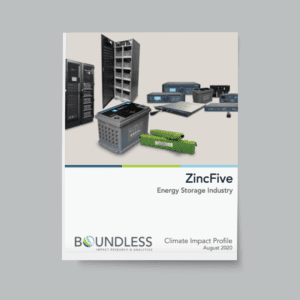
Now picture how NiZn batteries can help your data center optimize sustainability.  Click here to get your copy of the Climate Impact Profile by Boundless Impact Research & Analytics.

[1] Pure Earth/Green Cross 11th annual 2016 report, “World’s Worst Pollution Problems” https://www.worstpolluted.org/2016-report.html, “World’s Worst Pollution Problems”, Fact Sheet – Lead-Acid Battery Recycling and Lead Pollution; https://www.worstpolluted.org/projects_reports/display/133

[2] https://www.foeeurope.org/sites/default/files/publications/13_factsheet-lithium-gb.pdf

[3} https://www.zincfive.com/climate-impact-profile-registration

Author
Steve Jennings, ZincFive SR VP Sales & Marketing
Steve Jennings
Sr. VP Sales & Marketing, ZincFive
Steve leads the ZincFive sales and marketing team and brings senior executive experience in technology companies serving the energy, clean tech, communications, computing and semiconductor industries. Steve and his team are focused on providing superior performing, safer and greener energy storage solutions based on nickel-zinc batteries to mission critical applications in the data center, IT and intelligent transportation markets.
Tags:
  • batteries, 
  • Climate Impact, 
  • data centers, 
  • sustainable

Nickel-Zinc: High Power Density Backup Power for Data Centers

February 9, 2021

The Powerful and Safe Bet for the Data Center Footprint Challenge

Data center real estate is always at a premium. Every square foot used for servers and storage can generate more revenue. So reducing the power infrastructure footprint can boost revenue, impact safety and also has implications for backup capacity. We call this the Footprint Challenge.

For decades, the industry has relied on lead-acid backup batteries that have a large, heavy footprint. Some data center operators are looking to lithium-ion batteries for their smaller footprint and lighter weight. However, concerns over safety with lithium-ion energy storage systems have driven additional placement spacing requirements by the NFPA 855 standard for the Installation of Stationary Energy Storage Systems, requirements that can effectively cancel out the footprint savings of lithium-ion systems.

Safety measures eat up footprint

Energy storage system footprint is largely determined by battery power density. Yet a battery must deliver energy safely to realize power density-driven footprint reduction and savings. Without safe energy delivery, the authorities having jurisdiction (AHJ) have no choice but to enforce placement restrictions and other safety measures such as enhanced fire suppression that negate any footprint advantages.
High power density batteries that can operate safely are the right step to overcoming The Footprint Challenge. Understanding that lithium-ion batteries are not the right answer, let’s look at why lead-acid batteries can’t meet the challenge, then meet the type of battery that does—nickel-zinc (NiZn).

What you need is a power battery

To see why lead-acid batteries are a dead-end, you should know the fundamental differences between an “energy” battery and a “power” battery. If you are in an electric vehicle (EV), energy density is most important: being able to discharge the energy out of the battery at a lower rate for as long as possible to limit range anxiety. Billions of dollars are being spent globally to increase the energy density of EV batteries.

This won’t help your data center Footprint Challenge!

Data center backup batteries must discharge the battery at a high rate for a short period of time to maintain operations while long term power systems such as generators spin up. Battery power density is what delivers high rate discharge, ideally in a relatively small footprint.

A lead-acid battery is an “energy” battery, meaning the data center industry has been using the wrong tool for the job for a long time. NiZn batteries are “power” batteries that give you an edge in the Footprint Challenge.

Power density with inherent safety

With about twice the power density of lead-acid batteries, NiZn batteries are well suited to data center backup power applications. Backup systems available today based on nickel-zinc batteries offer the industry’s smallest footprint and lightest weight per watt in solutions ranging from 1 kW to 2MW. That’s the magic of power density.

Backup systems based on nickel-zinc batteries offer the smallest footprint and lightest weight per watt in solutions ranging from 1 kW to 2MW.

Unlike lithium-ion, NiZn technology has no inherent safety issues. To demonstrate this, we turn to the test method titled UL 9540A, Test Method for Evaluating Thermal Runaway Fire Propagation in Battery Energy Storage Systems. This UL test method is referenced in the NFPA 855 standard to assist AHJ’s in interpreting and enforcing NFPA 855 for different battery chemistries.Underwriters Laboratories tested ZincFive’s NiZn batteries at the “cell level”, the most fundamental level in the test method. ZincFive’sNiZn batteries did not exhibit thermal runaway in any of the five arduous and destructive test types that comprise the UL 9540A test method.

A high power density battery that delivers energy safely – it looks like we found a winner in the Footprint Challenge!

Now many battery manufacturers have had their batteries tested to the UL 9540A test method. You should understand that the UL 9540A test method allows different levels of testing in which a manufacturer can include a battery management system (BMS) and other safety measures in order to complete the tests without exhibiting thermal runaway. But make sure you ask what level of UL 9540A testing they used. Wouldn’t it be better to start with a power-dense battery chemistry that is fundamentally safe at the cell level?

Author
Steve Jennings, ZincFive SR VP Sales & Marketing
Steve Jennings
Sr. VP Sales & Marketing, ZincFive
Steve leads the ZincFive sales and marketing team and brings senior executive experience in technology companies serving the energy, clean tech, communications, computing and semiconductor industries. Steve and his team are focused on providing superior performing, safer and greener energy storage solutions based on nickel-zinc batteries to mission critical applications in the data center, IT and intelligent transportation markets.
Tags:
  • batteries, 
  • high power density, 
  • power battery, 
  • uninterruptible power supply

The Hidden Sustainability Challenge in your Data Center

February 9, 2021

Data centers make a big impact in our world. The number of data centers across the globe rose to roughly 9,100 in 2019 from 7,500 in 2018.[1] As a result, data center electricity consumption is projected to increase to roughly 140 billion kilowatt-hours in 2020 in the U.S. alone, which equates to about 150 million metric tons of carbon emissions.[2]

Sustainability is no longer optional, it has become an obvious priority for data center operators. They are committing to low or no carbon footprint operation by optimizing electronics efficiency and procuring renewable “green” energy. But there’s another sustainability problem in almost every data center: the lead-acid batteries that back up the UPS system.

To achieve sustainable power, it’s time to buy green batteries.


Avoid the world’s top pollution problems

The lead-acid manufacturing industry has done a good job of promoting the high rate of recycling for lead-acid batteries. But the business of recycling these batteries is not good for the environment, or the people who do the work.

Lead-acid batteries contain significant amounts of lead and other hazardous materials that create a highly pollutive and hazardous recycling process. In fact, environmental organizations have identified used lead-acid battery recycling as the world’s #1 pollution problem.[3] This is not a good footnote in anyone’s sustainability portfolio.

Lithium-ion batteries are often considered a “cleaner” option to lead-acid batteries. Yet they contain rare earth elements that are highly polluting to source. The extraction of lithium alone has significant environmental and social impacts, from water pollution and depletion to leaching, spills and air emissions of toxic chemicals.[4] And that’s simply for manufacturing: lithium-ion batteries do not yet have a clear, self-funded path to recyclability at end-of-life.


A truly green battery backup choice

To make the sustainable choice, data center operators should consider nickel-zinc (NiZn) batteries. NiZn batteries consist mainly of common highly available materials, are non-flammable and fail-safe with the lowest climate impact of battery chemistries popular in the data center.

NiZn batteries consist mainly of common highly available materials with the lowest climate impact of battery chemistries popular in the data center.


Moreover, both nickel and zinc can be recycled while maintaining their physical and chemical properties, making NiZn one of the most recyclable battery chemistries. In fact, the California Department of Transportation (Caltrans) has defined a Green Technology Battery Backup System (GT-BBS) standard that utilizes NiZn battery-based backup systems as a green alternative to lead-acid battery backup systems.


Superior GHG emissions savings

The most direct way to evaluate environmental impact is by comparing a battery’s Carbon Return on Purchase (CROP) with that of other chemistries.CROP measures the greenhouse gases (GHG) avoided per kWh of customer energy storage. ZincFive’s NiZn batteries offers six times or more avoidance of GHG emissions compared to lithium-ion and four times more compared to lead-acid chemistries, according to a Climate Impact Profile by Boundless Impact Research & Analytics.[5]

The Climate Impact Profile also compared the battery chemistries for Carbon Payback Time: the Time required for emissions savings from the product’s use to offset the GHG of its production. Comparing production and product use, the authors concluded that NiZin had, by far, the shortest Carbon Payback Time. Li-Ion and Lead-Acid batteries exhibit roughly 400% longer Carbon Payback Time.

A much higher CROP and shorter Carbon Payback Time contribute directly to higher sustainability value using NiZn battery technology. Analysis shows that data centers can realize significant GHG savings and optimize sustainability by investing in nickel-zinc batteries instead of lithium-ion and lead-acid batteries.

Click here for a copy of the Climate Impact Profile by Boundless Impact Research & Analytics.


[1] https://www.wsj.com/articles/data-center-market-is-booming-amid-shift-to-cloud-11566252481

[2] https://datacenterfrontier.com/today-and-tomorrow-sustainable-data-centers-start-with-design/

[3] Pure Earth/Green Cross 11th annual 2016 report, “World’s Worst Pollution Problems” https://www.worstpolluted.org/2016-report.html, “World’s Worst Pollution Problems”, Fact Sheet – Lead-Acid Battery Recycling and Lead Pollution; https://www.worstpolluted.org/projects_reports/display/133

[4] https://www.foeeurope.org/sites/default/files/publications/13_factsheet-lithium-gb.pdf

[5] https://www.zincfive.com/climate-impact-profile-registration

Author
Steve Jennings, ZincFive SR VP Sales & Marketing
Steve Jennings
Sr. VP Sales & Marketing, ZincFive
Steve leads the ZincFive sales and marketing team and brings senior executive experience in technology companies serving the energy, clean tech, communications, computing and semiconductor industries. Steve and his team are focused on providing superior performing, safer and greener energy storage solutions based on nickel-zinc batteries to mission critical applications in the data center, IT and intelligent transportation markets.
Tags:
  • batteries, 
  • data centers, 
  • high power density, 
  • power battery, 
  • uninterruptible power supply

Zinc Chemistry Challenges Lithium-Ion in 2021

February 9, 2021
ZincFive nickel-zinc cyclinderical batteries that are safe, powerful, reliable and sustainable

As we put 2020 in the rear-view mirror, most of us are anxious for a return to something resembling “normal” in 2021. But one area that is rapidly changing (and never going back) is energy storage.

Zinc chemistry will be one of the factors driving change this year.

An increasing number of industries are transforming due to rapidly improving battery technologies: from utility-scale energy storage at the large scale to ultra-small wearable goods at the small end. Lithium-ion technology has become the 800-lb gorilla in energy storage, displacing lead-acid batteries in some markets while creating entirely new markets.

In 2021, we’re going to see the most substantial challenge yet to lithium-ion energy storage by batteries based on zinc chemistries. Zinc has always had certain advantages over lithium: higher power density, greater reliability, safer operation and superior sustainability. Various configurations of zinc batteries are available with some noticeable advantages over lithium-ion batteries.

Safety and reliability suit lighter wearables

On the one hand, manufacturers can use safe and reliable Zinc chemistry to make batteries smaller than equivalent lithium-ion devices for many consumer markets. For example, zinc-air batteries deliver light weight and very small size by using oxygen in the air as a reactant, instead of a liquid or solid-state reactant. This explains their wide use for powering hearing aids. Now rechargeable zinc-silver batteries are replacing lithium-ion devices in new generations of consumer devices, wearables, and other products because of size and safety advantages.[1]

When power density is more important than energy density

On the other hand, high power density makes zinc battery technology a strong competitor in certain industrial applications. In this case it’s important to understand the differences between an “energy” battery and a “power” battery. An energy battery is engineered to provide power for a long period of time, at a lower rate of discharge. For example, lithium-ion batteries are the usual choice for electric vehicles (EVs), because providing energy over hundreds of miles of use is a critical requirement!

The other category—the power battery—can discharge at a very high rate for a relatively shorter period of time. High power density within a battery suits many industrial applications that need to quickly tap a power source for a short period of time. Zinc technologies are well suited to power batteries, able to sustain high-rate charge/discharge cycles safely and reliably.

Nickel-zinc moves into data centers

To illustrate, one large and growing industry segment with an urgent need for power on demand is the data center market. The need for backup power to keep important services online is accelerating as hyperscale data centers proliferate, and more technologies such as IoT and 5G drive the need for edge computing to reduce the response latency of their services. These trends are making data center architectures more distributed, so continuous uptime at every facility is critical for service performance and reliability.

In 2021, nickel-zinc (NiZn) batteries will gain momentum in data center markets, driven in large part by superior power density, safety, reliability and sustainability. NiZn batteries are smaller and lighter than the typical lead-acid batteries, so they can meet the power requirements of hyperscale data centers as well as the space constraints of the edge data centers.

NiZn chemistry is a “power battery” technology well suited to keeping data centers operating during a power outage. Unlike lithium-ion batteries (and lead-acid batteries, for that matter), NiZn batteries keep operating even when one or more cells in a battery string becomes weak or depleted. This attribute significantly increases reliability for mission critical applications.

Safety and sustainability for many markets

NiZn chemistry also makes data centers (and other applications) safer and more sustainable. In particular, ZincFive’s NiZn batteries are tested at the cell level to UL 9540A, a test method for evaluating thermal runaway fire propagation, and have not exhibited thermal runaway in any of the tests. This fundamentally safe battery chemistry reduces battery system costs and enables lower costs of construction, installation and operating expense due to reduced safety precautions.

Finally, a recent Climate Impact Report gave NiZn batteries the best climate impact score for any backup battery technology—9.4 out of 10. As sustainability becomes a top priority across major corporations, NiZn looks better and better.

In 2021 and the years beyond, these advantages position NiZn technology for not just for data centers, but also for aviation, EV charging, renewable energy storage and other markets.

Move over, lithium, zinc battery technology is the new “power player.”


[1] https://www.zpowerbattery.com/wp-content/uploads/2019/05/ZPower-FAQ-Electronic-Design.pdf

Tags:
  • batteries, 
  • data centers, 
  • high power density, 
  • nickel-zinc, 
  • uninterruptible power supply