UL Solutions Position on Large Scale Fire Testing for Nickel-Zinc
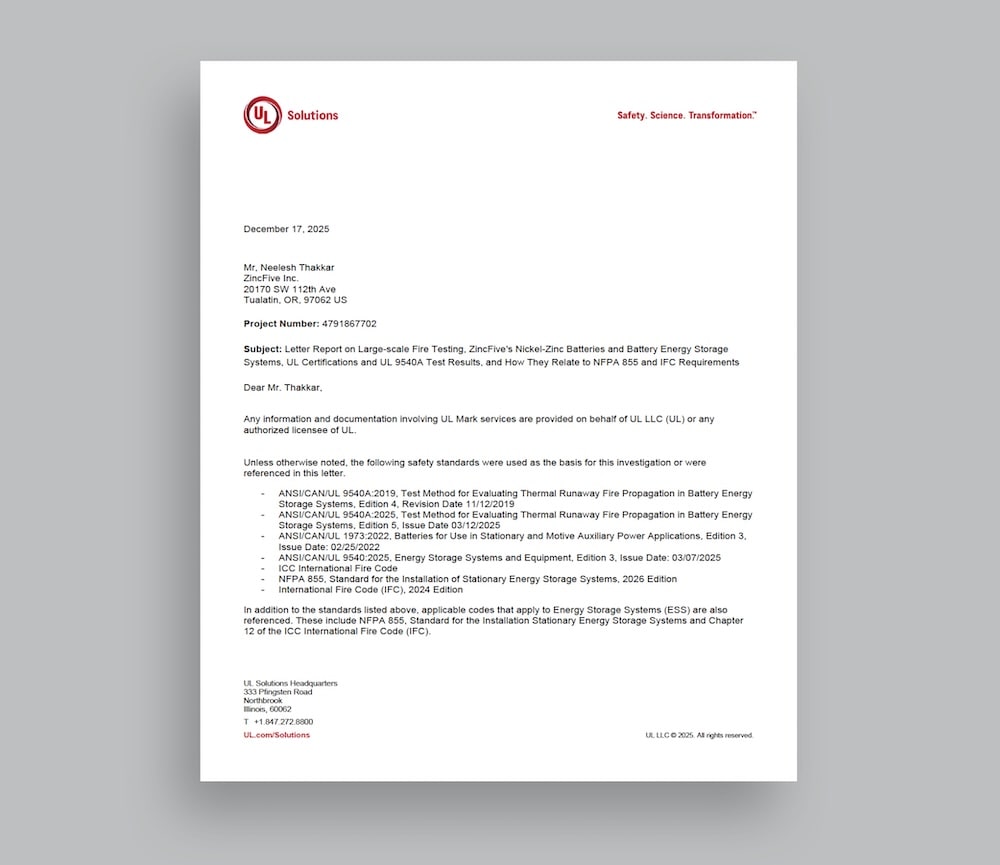
Description
This letter from UL Solutions provides clarification on the application of UL 9540A and Large-Scale Fire Testing (LSFT) requirements for ZincFive’s nickel-zinc battery technology.
During UL 9540A cell-level testing, ZincFive’s nickel-zinc monobloc batteries were subjected to multiple abuse methods intended to induce thermal runaway, including external heating, nail penetration, overcharge, overdischarge, and short circuit. The batteries did not enter thermal runaway under any of these conditions. Based on these results, a Large-Scale Fire Test was not required for nickel-zinc under UL 9540A .
The testing also identified hydrogen generation, a known characteristic of aqueous battery chemistries. Hydrogen accumulation is addressed through established ventilation requirements under applicable UL standards, NFPA 855, and the International Fire Code. As outlined in the letter, the 2026 edition of NFPA 855 exempts qualifying aqueous nickel-based batteries, including ZincFive’s nickel-zinc chemistry, from UL 9540A and large-scale fire testing requirements.
Register to read full letter
December 17, 2025
Mr, Neelesh Thakkar
ZincFive Inc.
20170 SW 112th Ave
Tualatin, OR, 97062 US
Project Number: 4791867702
Subject: Letter Report on Large-scale Fire Testing, ZincFive’s Nickel-Zinc Batteries and Battery Energy Storage Systems, UL Certifications and UL 9540A Test Results, and How They Relate to NFPA 855 and IFC Requirements
Dear Mr. Thakkar,
Any information and documentation involving UL Mark services are provided on behalf of UL LLC (UL) or any authorized licensee of UL.
Unless otherwise noted, the following safety standards were used as the basis for this investigation or were referenced in this letter.
- ANSI/CAN/UL 9540A:2019, Test Method for Evaluating Thermal Runaway Fire Propagation in Battery Energy
Storage Systems, Edition 4, Revision Date 11/12/2019 - ANSI/CAN/UL 9540A:2025, Test Method for Evaluating Thermal Runaway Fire Propagation in Battery Energy
Storage Systems, Edition 5, Issue Date 03/12/2025 - ANSI/CAN/UL 1973:2022, Batteries for Use in Stationary and Motive Auxiliary Power Applications, Edition 3,
Issue Date: 02/25/2022 - ANSI/CAN/UL 9540:2025, Energy Storage Systems and Equipment, Edition 3, Issue Date: 03/07/2025
- ICC International Fire Code
- NFPA 855, Standard for the Installation of Stationary Energy Storage Systems, 2026 Edition
- International Fire Code (IFC), 2024 Edition
In addition to the standards listed above, applicable codes that apply to Energy Storage Systems (ESS) are also referenced. These include NFPA 855, Standard for the Installation Stationary Energy Storage Systems and Chapter 12 of the ICC International Fire Code (IFC).
The information in this letter is based on the documented test results from ZincFive’s UL 9540A Cell Level Test Reports that were issued by UL Solutions. This information is also based on ZincFive’s ANSI/CAN/UL 1973 Listing (File Number MH62563) for their battery systems and ANSI/CAN/UL 9540 Listing (File Number E540538) for their Energy Storage Equipment Subassembly – DC ESS that utilize ZincFive’s nickel-zinc monobloc batteries and were issued by UL Solutions.
ZincFive manufactures nickel-zinc monobloc batteries for use in stationary applications. Their monobloc batteries were submitted for the UL 9540A Cell Level Test. The batteries were subjected to the following cell abuse methods of UL 9540A to achieve a thermal runaway condition: external thin film heating, nail penetration, overcharge, overdischarge, and short-circuit. After each of the methods, the monobloc batteries did not go into thermal runaway. Based on these results, continued testing under UL 9540A is not required.
The 2026 edition of NFPA 855 exempts aqueous nickel-based batteries as well as lead-acid and aqueous metal-air batteries that are vented or are listed to UL 1973 from UL 9540A testing and large-scale fire testing. ZincFive’s nickelzinc monobloc batteries have an aqueous electrolyte that meets this exemption. Additionally, any battery energy storage system (BESS) or uninterruptible power supply (UPS) or other energy storage application that utilizes this chemistry are exempt from UL 9540A and large-scale fire testing.
The off-gassing from the monoblocs when subjected to the ANSI/CAN/UL 9540A Cell Level Test showed a concentration of hydrogen greater than the LFL (Lower Flammability Limit) of 4.0%. The high concentration of hydrogen is due to the fact that the electrolyte is water-based, and hydrogen is a byproduct of the internal chemical reaction.
As previously mentioned, battery energy storage systems that employ the nickel-zinc monobloc batteries are Listed to ANSI/CAN/UL 1973 and to ANSI/CAN/UL 9540. Both standards require battery systems to employ ventilation openings having a minimum opening area to prevent accumulation of flammable gases within an enclosure. Specifically mentioned is hydrogen gas, due to electrolysis of aqueous electrolytes for applicable battery technologies, such as vented or valve regulated lead acid and nickel batteries.
Chapter 12 of the International Fire Code covers Electrical Energy Storage Systems (ESS). Section 1207.6, “Electrochemical ESS technology-specific protection”, addresses requirements for exhaust ventilation in a room or area with electrochemical ESS. NFPA 855, Paragraph 9.7.6, “Technology-Specific Requirements” also highlights requirements for exhaust ventilation for electrochemical ESS that employ nickel-zinc battery chemistry.
Based on the IFC and NFPA 855, design of an adequate ventilation system shall be coordinated with the site designer to ensure that the exhaust ventilation for the ZincFive battery systems is capable of maintaining a flammable gas concentration below a maximum concentration of 25% of the LFL of hydrogen.
ANSI/CAN/UL 9540A (cell, module, and unit) testing and large-scale fire testing are not required for battery systems that utilize nickel-zinc batteries as indicated in NFPA 855. The ANSI/CAN/UL 9540A Cell Level Test previously conducted on the nickel-zinc monobloc batteries have demonstrated the inability of this chemistry to experience a thermal runaway event.
This concludes the work anticipated for this investigation and we are closing this project with this letter. No samples were provided for this investigation.
If you have any questions on the information provided in this letter or about UL processes, do not hesitate to contact the undersigned.
Sincerely,
LaTanya Schwalb Joe Bablo
Principal Engineer Principal Engineer Manager
Energy & Industrial Automation Energy & Industrial Automation
UL Solutions UL Solutions
LaTanya.Schwalb@ul.com
-

Featured Papers A Comprehensive Guide to the U.S. Codes and Standards for Energy Storage Systems (ESS)
This white paper provides an informational guide to the United States Codes and Standards regarding Energy Storage Systems (ESS), including battery storage systems for uninterruptible power supplies and other battery backup systems.
June 28, 20241 / 2 -

Featured Papers Climate Impact Profile
Advanced energy storage solutions are increasingly needed to transition the electricity grid, transportation, building and industrial sectors towards renewable energy sources. ZincFive’s nickel-zinc battery is a high-capacity battery with environmental and safety advantages.
June 28, 20242 / 2